New research reveals a surprising link between Aquaporin-4, a protein that manages water in the brain, and the debilitating freezing of gait and impaired balance learning experienced by many with Parkinson’s disease.
For many living with Parkinson’s disease (PD), one of the most frustrating and dangerous symptoms is the “freezing of gait” (FOG). It’s a sudden, involuntary inability to move your feet, as if they’ve been glued to the floor, often happening mid-stride. This phenomenon is a leading cause of falls and significantly impacts quality of life. For years, the precise biological reasons behind FOG have remained a puzzle. Why do some individuals with PD experience it while others don’t? And how is it connected to the broader challenges with balance and learning new movements?
A recent study published in Scientific Reports shines a new light on this mystery, pointing to an unexpected culprit: a protein called Aquaporin-4 (AQP4). Best known as a “water channel” that helps regulate fluid balance in the brain, AQP4 is now emerging as a key player in the neurodegenerative landscape of Parkinson’s. The research suggests that elevated levels of this protein in the bloodstream are not only linked to FOG but are also associated with a reduced ability to learn new balance skills, offering a crucial new piece of the puzzle.
The Protein Marker for Freezing
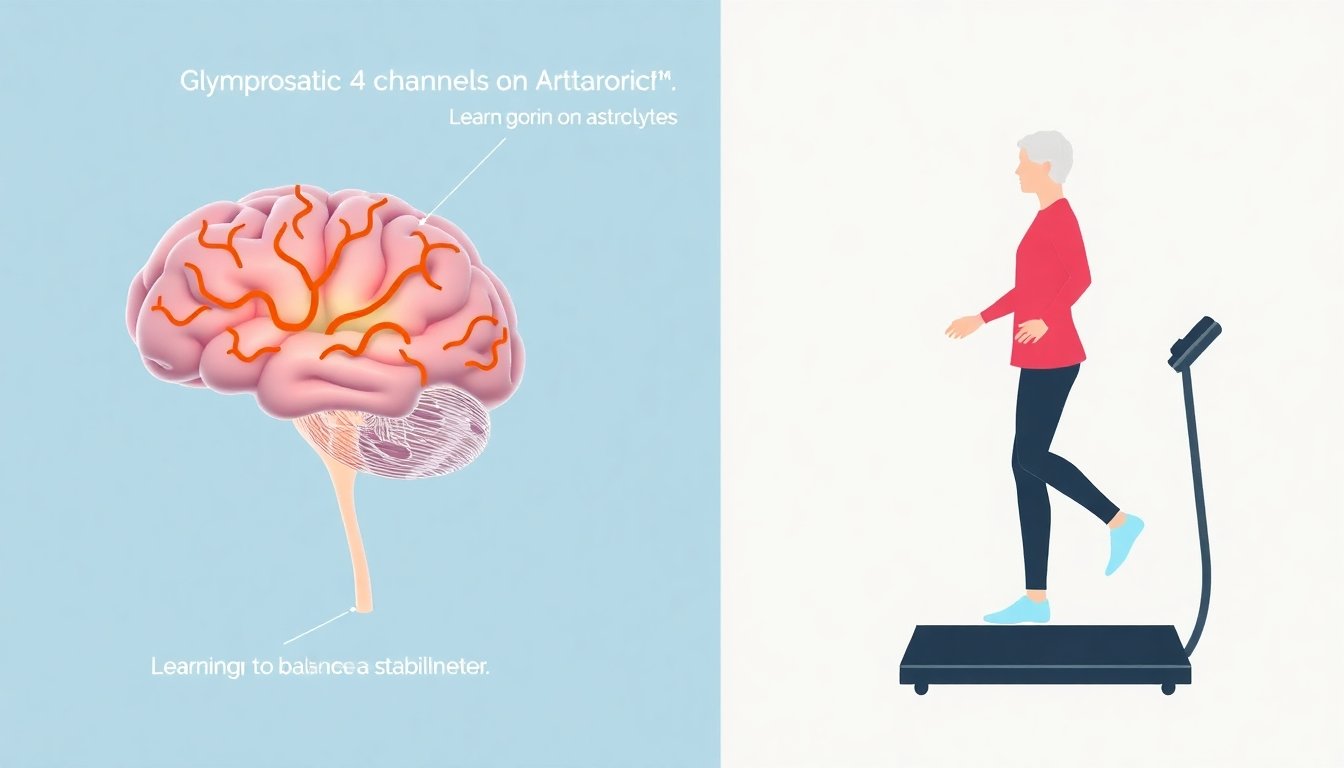
Aquaporin-4 channels are tiny pores located on the surface of astrocytes, the star-shaped support cells of the brain. Their primary job is to manage the flow of water, playing a vital role in the brain’s “glymphatic system”—a waste clearance network that flushes out toxins during sleep.
In this new study, researchers set out to see if AQP4 had any connection to FOG. They collected blood samples from three groups: people with PD who experience FOG, people with PD who do not, and healthy individuals. The results were striking. The group with FOG had significantly higher levels of AQP4 in their blood serum compared to the other two groups. Furthermore, the researchers found a direct correlation: the more severe a person’s FOG symptoms were, the higher their AQP4 levels tended to be.
Crucially, the team controlled for other factors that could influence these results, such as disease duration, cognitive function, anxiety, and sleep quality. None of these could account for the dramatic difference in AQP4 levels, suggesting the link to freezing of gait was specific and strong. This finding positions serum AQP4 as a promising new biomarker—a measurable indicator—for this challenging Parkinson’s symptom.
The Struggle to Learn and Adapt
The investigation didn’t stop at a simple blood test. The researchers wanted to explore the functional consequences. Since FOG is fundamentally a problem of motor control, they designed an experiment to test dynamic balance learning—the ability to acquire and retain a new motor skill.
Participants were tasked with balancing on a stabilometer, a device akin to a high-tech wobble board that requires constant, conscious postural adjustments to keep it level. Over several days, they practiced this challenging task.

The results revealed a clear divide in learning ability. While all participants with Parkinson’s performed worse than the healthy controls initially, the group without FOG showed a capacity to improve their balance time during the first day of training. In stark contrast, the group with FOG demonstrated almost no ability to learn the task. Their performance barely improved, highlighting a significant impairment in what neuroscientists call motor skill acquisition. This deficit in learning was also directly correlated with the severity of their FOG symptoms.
Connecting AQP4 to Impaired Learning
Here is where the two key findings of the study converge. When the researchers analyzed all the data together, they discovered a powerful negative correlation: the higher a person’s serum AQP4 levels, the poorer their ability to learn the dynamic balance task.
This suggests that AQP4 is more than just a passive marker of FOG. It may be actively involved in the underlying brain processes that disrupt motor learning. The brain circuits responsible for learning new movements—involving regions like the cerebellum, basal ganglia, and prefrontal cortex—are known to be affected in Parkinson’s, particularly in those with FOG. AQP4’s role in brain inflammation, synaptic plasticity (the strengthening or weakening of connections between neurons), and waste clearance could directly impact the efficiency of these learning circuits. Dysregulation of AQP4 could therefore create a brain environment that is less conducive to forming the new neural pathways required to master a skill like balancing on a stabilometer.
Why the Rise in AQP4?
If elevated AQP4 is a sign of trouble, what is causing its levels to rise? The study’s authors propose several interconnected possibilities, which are now avenues for future research:
- A Protective Response Gone Awry: The brain might be increasing AQP4 production as a defense mechanism to try and clear out toxic proteins associated with Parkinson’s, such as alpha-synuclein. This overproduction could lead to excess AQP4 spilling into the bloodstream.
- A Leaky Blood-Brain Barrier: In Parkinson’s, the protective barrier between the brain and the bloodstream can become compromised. This “leakiness” could allow AQP4, which is normally contained within the brain, to escape into the general circulation.
- A Problem Starting in the Periphery: Some theories suggest Parkinson’s may originate in the body (e.g., the gut) before reaching the brain. If so, peripheral inflammation could trigger a rise in blood AQP4 levels, which then contributes to dysfunction in the brain.
Conclusion: A New Direction for Research and Treatment
This study provides compelling, first-of-its-kind evidence linking elevated serum Aquaporin-4 to both the presence of freezing of gait and impaired voluntary motor learning in people with Parkinson’s disease. It opens up an exciting new chapter in our understanding of this complex condition.
The findings suggest that AQP4 could serve as a valuable biomarker, helping clinicians identify patients at higher risk for FOG and track its progression. More importantly, it points toward a novel therapeutic target. If AQP4 dysregulation is indeed a driver of these symptoms, developing treatments that can modulate its function or address the underlying inflammation could offer a new way to help patients regain mobility and the ability to learn and adapt.
While the study is preliminary and requires confirmation with larger groups of patients, it marks a significant step forward. By looking at the brain’s humble water channels, we may have found a key to unlocking one of the most challenging aspects of Parkinson’s disease.
Reference
Jazaeri, S. Z., Shahrbanian, S., Aarabi, M. H., Shoeibi, A., Saeedi, R., & Shahidi, G. A. (2024). The Role of Aquaporin-4 in Freezing of Gait and Dynamic Balance Learning in Parkinson’s Disease. Scientific Reports, 14(1), 15161. https://doi.org/10.1038/s41598-024-65881-z