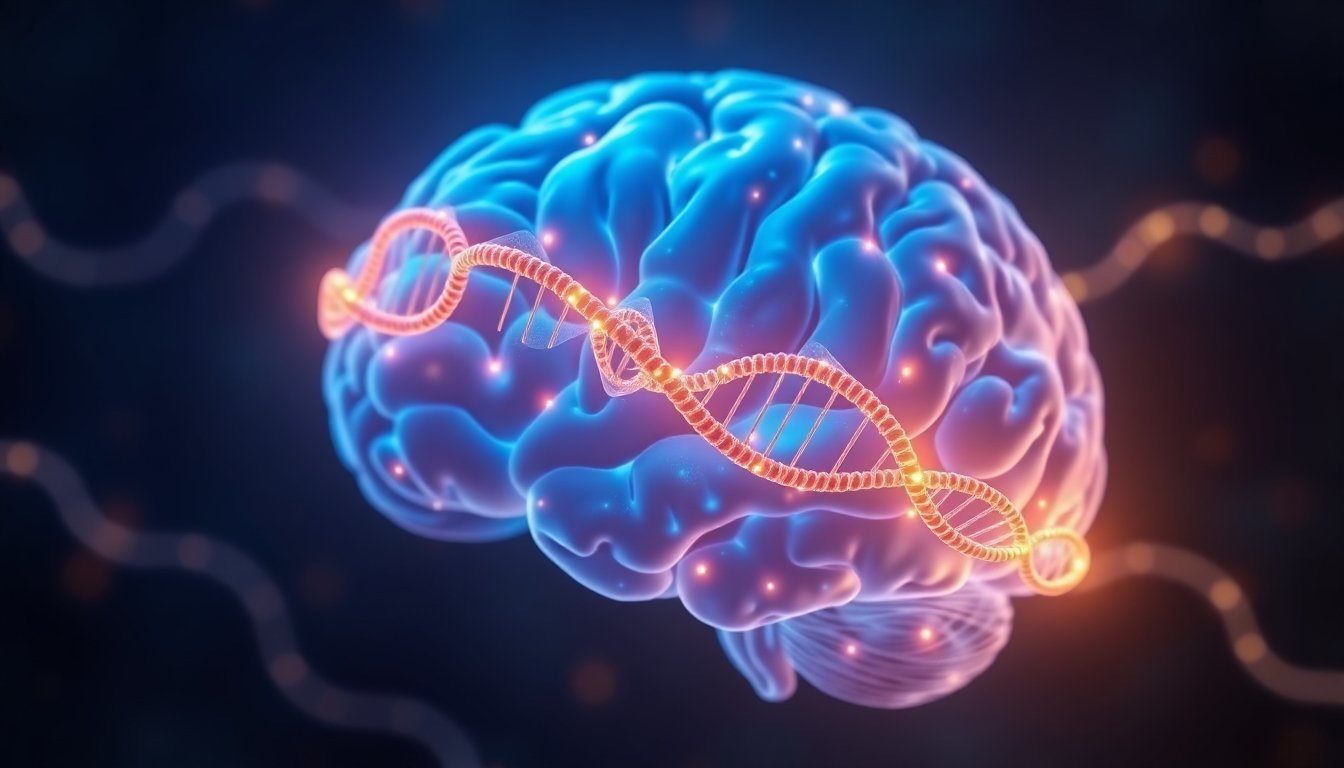
For decades, scientists dismissed 98% of our DNA as useless. A groundbreaking study reveals these hidden sequences are actually crucial conductors of brain development and may hold the key to understanding complex neurological diseases.
Imagine the DNA double helix, the iconic blueprint of life containing all the instructions needed to build a human being. Now, what if it turned out that most of that blueprint was written in a language we had long dismissed as gibberish? For decades, that’s precisely how science viewed the vast majority of our genome. Only about 1.5% of our DNA consists of genes that code for proteins—the functional building blocks of our bodies. The other 98.5% was unceremoniously labeled “junk DNA,” considered little more than evolutionary leftovers collecting dust in our cells.
A paradigm-shifting study from Lund University is forcing a major rewrite of that narrative. Published in the journal Cell Genomics, the research reveals that this supposed “junk” is, in fact, a master architect of our most complex organ: the brain. This hidden part of the genome is active, influential, and essential for proper neurodevelopment, and it may hold the secrets to both human evolution and devastating brain disorders.
Rethinking the Genome’s ‘Dark Matter’
The idea of “junk DNA” was always a bit of a puzzle. It seemed inefficient for nature to preserve so much genetic material across millennia without a purpose. Over the last couple of decades, scientists began to suspect this non-coding DNA wasn’t junk at all. Instead of providing direct instructions for proteins, it appeared to function as a sophisticated regulatory system—a massive, intricate switchboard that tells our genes when and where to turn on or off. This control is essential for everything from moment-to-moment cellular processes to the development of an entire organism. The latest research takes this understanding to a new level, zeroing in on how these sequences orchestrate the complex construction of the human brain.
Meet the ‘Jumping Genes’
At the heart of this discovery are peculiar DNA sequences known as transposable elements, or more colloquially, “jumping genes.” As their name suggests, these elements have the remarkable ability to move around and copy themselves within the genome. The research team at Lund, led by Professor Johan Jakobsson, focused on one specific and abundant family called LINE-1 (L1) transposons. These are ancient sequences that make up a significant portion of our DNA.
“Previously we assumed this part of the genome was switched off and just sitting quietly in the background,” Jakobsson explains in a press release. “It turns out that’s a misconception.” His team set out to discover what these supposedly silent elements were actually doing during the critical early phases of brain formation.
A Window into the Developing Brain
To investigate the role of L1 transposons, the researchers employed a trio of cutting-edge technologies. First, they used induced pluripotent stem cells (iPSCs), which are adult cells (like skin cells) that have been reprogrammed back into a pristine, stem-cell-like state, capable of becoming any type of cell in the body. They then guided these iPSCs to develop into brain cells.
Second, they grew these cells into cerebral organoids—miniature, simplified versions of the human brain, often called “mini-brains” in a dish. These organoids mimic the early stages of brain development, providing an invaluable model for studying a process that is otherwise impossible to observe directly in humans. Finally, they used the revolutionary CRISPR gene-editing tool. This technology allowed them to act like genetic surgeons, precisely targeting and switching off the L1 transposons to observe the consequences.

The Sound of Silence Has Consequences
The results were striking. When the L1 transposons were silenced using CRISPR, the “mini-brains” didn’t develop properly. The researchers observed significant disruptions in gene activity, and the organoids themselves grew abnormally, ending up noticeably smaller than their counterparts with active L1 elements. This was the smoking gun. These “junk” sequences were not silent passengers; they were active and essential players in the construction of the brain.
“These elements are not silent; they are active in human stem cells and seem to play an important role in early brain development,” says Jakobsson. “And we found that when you block them, there are real consequences.” The study showed that L1s can act as cis-acting regulators, meaning they influence the activity of genes located nearby on the same chromosome, directly shaping the genetic programs that build the brain from the ground up.
Unlocking Clues to Evolution and Disease
This discovery has profound implications that stretch across two major fields: evolutionary biology and medicine. From an evolutionary standpoint, L1 transposons are particularly active in hominoids (the group including humans and other great apes). This could help answer one of the biggest questions in science: how did the human brain evolve to be so different from that of our closest primate relatives? “From an evolutionary perspective, this could help explain how the human brain developed differently from that of other primates,” Jakobsson notes. These mobile genetic elements may have provided a source of genetic innovation that drove the rapid expansion and complexity of the human brain.
Perhaps more immediately, the findings open a new frontier for understanding brain disorders. Many of the genes that were affected when the L1 transposons were silenced are already known to be associated with neurodevelopmental conditions and psychiatric disorders. This suggests that malfunctions in these non-coding regions could be a root cause of some of these complex conditions. “If we want to fully understand neurodevelopmental disorders or neuropsychiatric conditions, we have to study this part of the genome,” Jakobsson emphasizes.
The Next Chapter in Our Genetic Story
The work doesn’t stop here. Jakobsson’s team is now part of a global effort, the ASAP (Aligning Science Across Parkinson’s) Collaborative Research Network, to explore this further. They plan to analyze patient-derived cells and donated brain tissue from individuals with neurodevelopmental disorders and age-related conditions like Parkinson’s disease. The goal is to map out exactly how these hidden regulators contribute to disease and, ultimately, to leverage that knowledge to design new and more effective treatments.
This study is a powerful reminder that our understanding of the genome is still evolving. The “junk” of yesterday is the treasure of today—a vast, dynamic, and powerful part of our DNA that is fundamental to what makes us human. By learning to read this once-ignored script, we may finally unlock the secrets of our own minds and find answers to some of the most devastating diseases that affect the brain.
Reference
Jakobsson, J., et al. (2024). LINE-1 retrotransposons mediate cis-acting transcriptional control in human pluripotent stem cells and regulate early brain development. Cell Genomics.