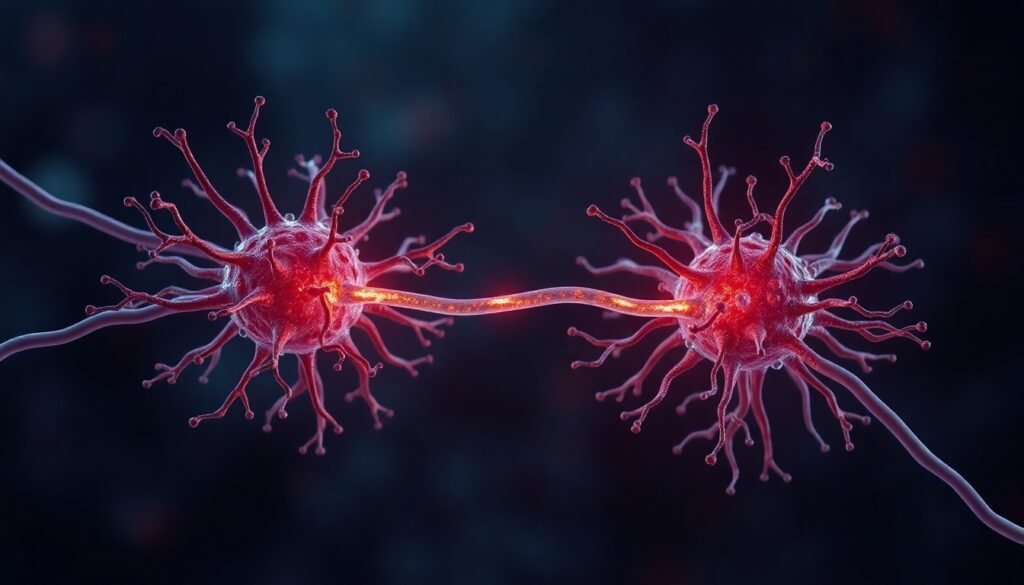
New research in mice reveals that the same brain cells can both promote and suppress alcohol consumption by sending two different chemical signals, a discovery with major implications for understanding addiction.
Alcohol Use Disorder (AUD) affects millions of people worldwide, yet its underlying neurobiology remains a complex puzzle. We know that patterns like binge drinking can increase the risk of developing AUD, but the precise mechanisms that tip the scales from casual use to dependence are still being uncovered. Scientists have long focused on the brain’s stress and reward circuits, particularly a region called the bed nucleus of the stria terminalis (BNST), a key player in anxiety and fear.
A neuropeptide called corticotropin-releasing factor (CRF), famous for its role in the body’s stress response, has been a prime suspect in driving excessive alcohol intake. The theory has been that stress and chronic alcohol use create a negative emotional state, and the brain releases CRF, which in turn drives further drinking as a form of self-medication. However, treatments targeting this system have had mixed results. A new study from researchers at the University of North Carolina at Chapel Hill suggests why: the story is far more intricate than we thought. It turns out the very same neurons that release the pro-drinking CRF signal may also be sending a second, opposing signal that puts the brakes on consumption.
A Tale of Two Signals from a Single Cell
The central challenge for the researchers was to figure out how to isolate the effects of two different neurotransmitters—CRF and GABA—when they are released from the exact same population of neurons in the BNST. Most neurons in this group are GABAergic, meaning their primary job is to release GABA, the brain’s main inhibitory, or "calming," neurotransmitter. But they also co-release the peptide CRF. So, when these cells are active, are they hitting the gas with CRF, the brake with GABA, or both?
To untangle this, the scientific team employed sophisticated genetic tools in mice. Using harmless viruses, they delivered molecular instructions that could selectively "knock down," or reduce, the production of either CRF or a protein essential for GABA release (the vesicular GABA transporter, vGAT). This allowed them to create two groups of mice: one where the BNST neurons couldn’t effectively release CRF, and another where they couldn’t release GABA, while leaving the other signal intact.
These mice were then placed in an environment where they could voluntarily work for a reward by pressing a lever. The reward was a solution of 9% ethanol mixed with sucrose—roughly equivalent to a sweet Moscato wine—a setup designed to model voluntary binge-like drinking. By measuring how often the mice pressed the lever, the researchers could directly assess their motivation to consume alcohol.
The Accelerator and the Brake
The results revealed a stunning duality. When researchers knocked down CRF, they saw a clear effect: male mice drank significantly less alcohol and were less motivated to work for it. Interestingly, this effect was specific to alcohol; their desire to work for a simple sugar-water reward was completely unaffected. This suggests that CRF released from these BNST neurons acts as a specific "accelerator" for alcohol consumption, driving the motivation and reinforcing properties of the drug.
But what happened when they silenced the GABA signal? The outcome was the complete opposite. Male mice with reduced GABA release from their BNST-CRF neurons actually increased their alcohol consumption, especially during the initial days of the experiment. It was as if their natural braking system had been disabled. This finding strongly suggests that while CRF from these cells says "go," the co-released GABA says "stop," creating a delicate push-and-pull that regulates drinking behavior.

Sex Differences and the Bigger Picture
Crucially, these effects were not always the same in male and female mice. While the CRF knockdown clearly reduced alcohol intake in males, the effect was much more subtle in females. Similarly, the increase in drinking after GABA knockdown was only observed in males. These sex-specific differences are a critical finding, underscoring that the neural circuits governing addiction are not one-size-fits-all. This could help explain why some treatments for AUD that showed promise in preclinical studies (often conducted only in male animals) have failed in human clinical trials that included women.
This study fundamentally changes our understanding of how brain circuits operate. It moves beyond a simple model where one neuron type has one function. Instead, it reveals a far more elegant and complex system where a single population of cells can exert bidirectional control over a complex behavior like alcohol consumption. By releasing a peptide (CRF) on a slower timescale and a classical neurotransmitter (GABA) on a faster one, the brain can fine-tune its response with incredible precision.
This discovery has profound implications for developing future therapies for AUD. Simply blocking the CRF system, as some past approaches have tried, might be too blunt an instrument. If that same system is also responsible for a "stop" signal via GABA, a simple blocker could have unintended consequences. The future of treatment may lie in developing more nuanced interventions that can selectively modulate specific arms of these complex circuits—perhaps by enhancing the GABAergic brake rather than just trying to disable the CRF accelerator.
By meticulously dissecting the roles of these two opposing signals, this research provides a vital piece of the addiction puzzle. It highlights that to truly understand and treat a condition as complex as AUD, we must appreciate the intricate, multi-layered, and often contradictory conversations happening within our own brains.
Reference
Levine, O. B., Skelly, M. J., Miller, J. D., Rivera-Irizarry, J. K., Rowson, S. A., DiBerto, J. F., … & Kash, T. L. (2025). Disentangling the effects of corticotrophin releasing factor and GABA release from the bed nucleus of the stria terminalis on ethanol self-administration in mice. Neuropsychopharmacology. https://doi.org/10.1038/s41386-025-02192-2