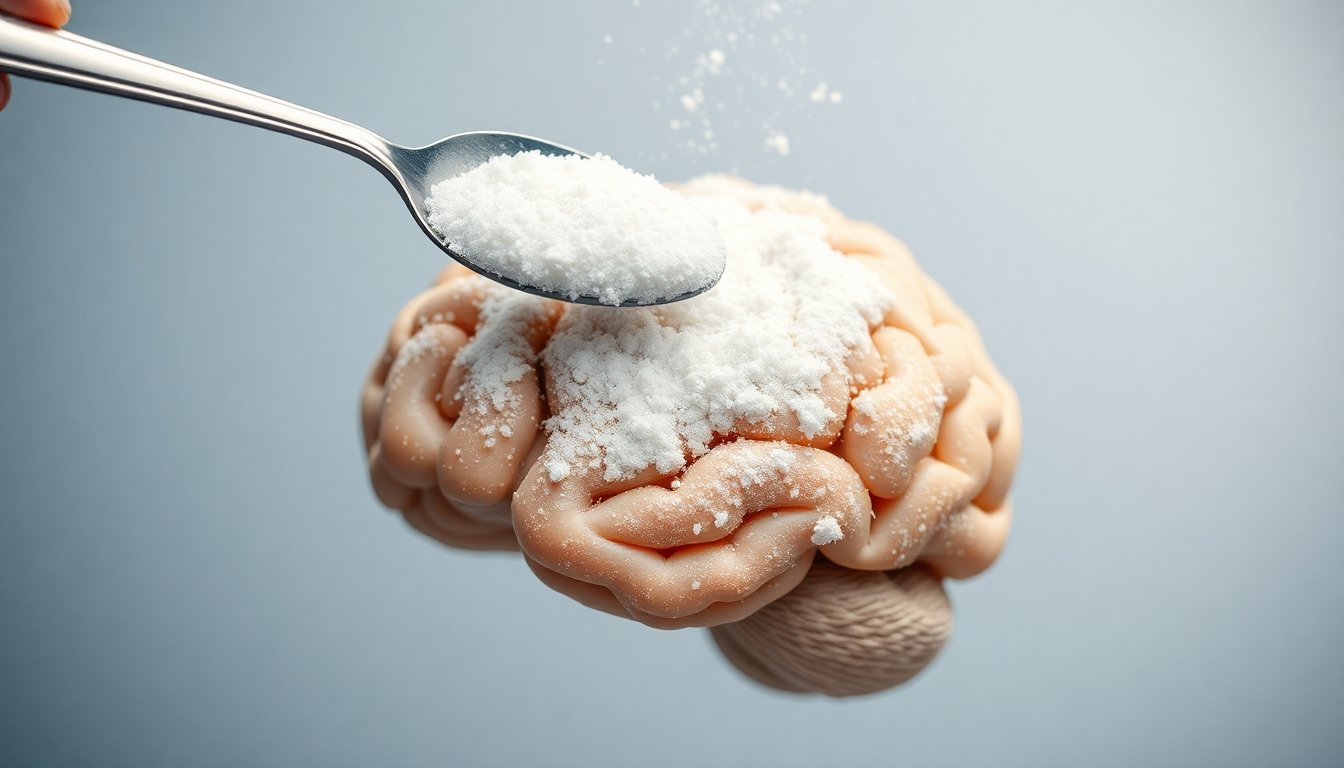
An eight-year study of nearly 13,000 adults suggests a surprising connection between common sugar substitutes and accelerated memory and thinking decline, especially in younger adults and those with diabetes.
For decades, low- and no-calorie sweeteners have been hailed as a guilt-free solution for satisfying a sweet tooth. Marketed as a healthy alternative to sugar, they are staples for individuals managing their weight, and particularly for those with diabetes. But what if this seemingly harmless swap comes with a hidden, long-term cost to our most vital organ—the brain? A major new study published in the journal Neurology is raising precisely these questions, suggesting a troubling link between the consumption of certain artificial sweeteners and a faster rate of cognitive decline.

The large-scale study, conducted over an average of eight years, paints a concerning picture. Researchers found that individuals who consumed the highest amounts of these sweeteners experienced a decline in their thinking and memory skills that was a staggering 62% faster than those who consumed the lowest amounts. To put that into perspective, the researchers calculated this accelerated decline was equivalent to adding 1.6 years of aging to the brain. Even those in the middle-consumption group weren’t spared, showing a 35% faster decline, equivalent to about 1.3 years of aging.
“Low- and no-calorie sweeteners are often seen as a healthy alternative to sugar, however our findings suggest certain sweeteners may have negative effects on brain health over time,” stated study author Dr. Claudia Kimie Suemoto of the University of São Paulo in Brazil. Her team’s findings challenge the prevailing wisdom and urge a closer look at what we’re putting into our bodies.
A Deeper Dive into the Data
To arrive at these conclusions, the researchers followed a massive cohort of 12,772 adults from across Brazil, with an average starting age of 52. At the beginning of the study, participants filled out detailed dietary questionnaires about their food and drink consumption over the past year. Based on their intake of seven specific low- and no-calorie sweeteners (LNCSs), they were divided into three groups: low, medium, and high consumers. The highest group consumed an average of 191 milligrams per day (mg/day), an amount that could be found in just a single can of diet soda, depending on the sweetener.
Throughout the eight-year follow-up period, participants underwent a series of cognitive tests at the start, middle, and end of the study. These tests were designed to measure key brain functions, including memory, language skills, verbal fluency, working memory, and processing speed. By comparing the test results over time, the researchers could track the rate of cognitive change for each participant.
After carefully adjusting for other factors that could influence brain health—such as age, sex, high blood pressure, and cardiovascular disease—the link between high sweetener consumption and faster cognitive decline remained robust.
Not All Brains—or Sweeteners—Are Affected Equally
The picture becomes even more complex when looking at specific demographics. The study revealed two particularly vulnerable groups:
- People with Diabetes: The association between sweetener use and cognitive decline was significantly stronger in participants with diabetes. This is a particularly poignant finding, as this is the very group most often advised to use sugar substitutes to manage their condition. “While we found links to cognitive decline for middle-aged people both with and without diabetes, people with diabetes are more likely to use artificial sweeteners as sugar substitutes,” Dr. Suemoto noted.
- Adults Under 60: Surprisingly, the negative effects were most pronounced in the younger half of the cohort. People under the age of 60 who were high consumers of sweeteners showed faster declines in verbal fluency and overall cognition. In contrast, the researchers did not find a statistically significant link in participants over the age of 60. The reasons for this age-related difference are not yet clear and present a compelling avenue for future research.
Furthermore, the study distinguished between different types of sweeteners. Six of the seven sweeteners examined were associated with a faster decline in overall cognition, especially memory. These included some of the most common names on the market: aspartame, saccharin, acesulfame-K, erythritol, sorbitol, and xylitol. These are frequently found in a vast array of ultra-processed foods, from flavored waters and sodas to yogurts and low-calorie desserts.
However, one sweetener, tagatose, stood out as an exception. The study found no link between its consumption and cognitive decline, suggesting that the biological mechanisms and long-term effects may vary significantly from one sweetener to another.
Correlation, Not Causation: An Important Distinction
It is crucial to interpret these findings with scientific caution. This was an observational study, meaning it identified a strong association, or correlation, between two things: high sweetener intake and cognitive decline. It does not, and cannot, prove that the sweeteners caused the decline. It’s possible that other lifestyle factors, not fully captured by the study, could be at play. For instance, people who consume high amounts of artificial sweeteners might also have other dietary habits or health behaviors that contribute to poorer brain health.
The authors themselves acknowledge these limitations. The dietary information was self-reported, which can be prone to inaccuracies, and not every type of artificial sweetener available was included in the analysis. Despite these caveats, the study’s large size, long duration, and robust statistical analysis make its findings difficult to ignore.
This research serves as a critical reminder that ‘healthy’ is a complex and evolving concept. As we continue to engineer our food supply to cut calories and sugar, we must remain vigilant about the potential unintended consequences. Dr. Suemoto suggests that more research is needed to confirm these findings and to explore whether other sugar alternatives, such as applesauce, honey, or maple syrup, might be safer for long-term cognitive function.
For now, this study provides compelling food for thought, encouraging us to read labels more carefully and perhaps reconsider our reliance on artificial substitutes in the pursuit of health.
Reference
Suemoto, C. K., et al. (2025). Association Between Consumption of Low- and No-Calorie Artificial Sweeteners and Cognitive Decline: An 8-Year Prospective Study. Neurology.