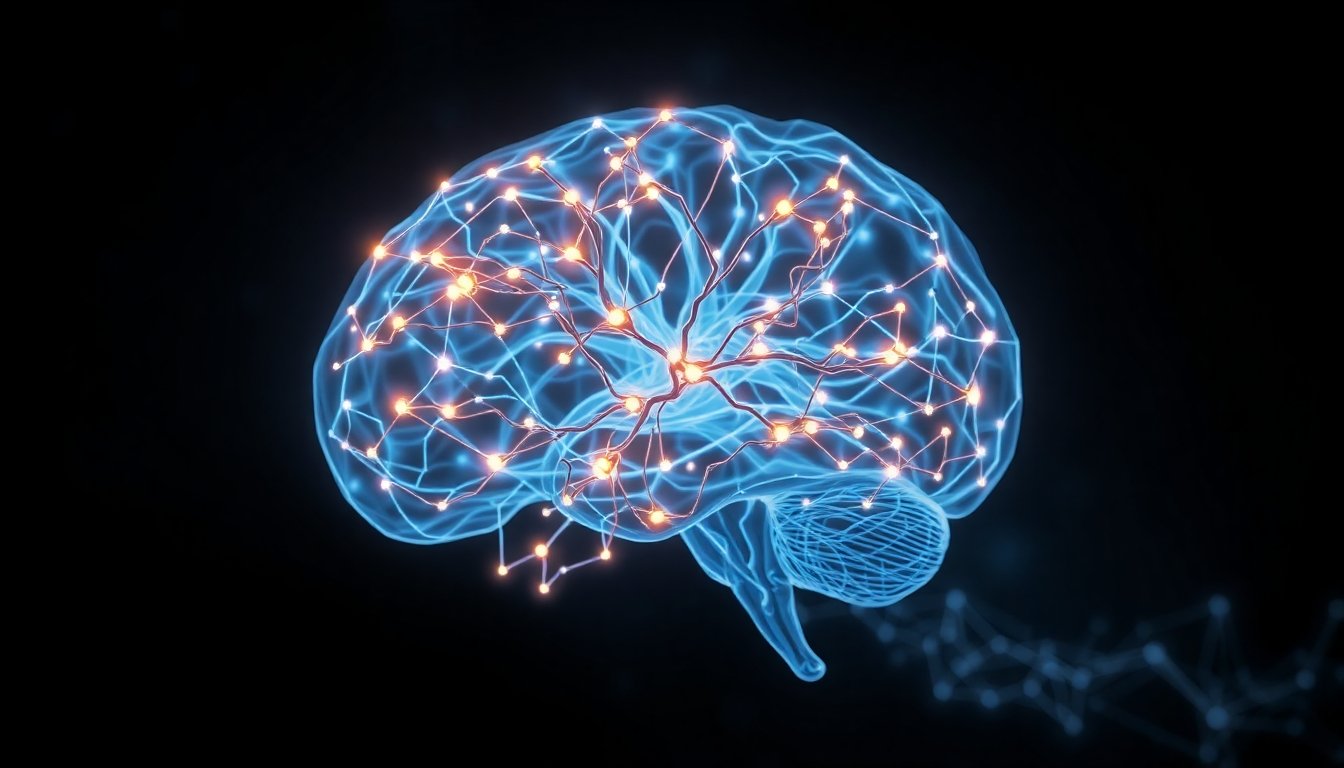
Neuroscientists have developed a new, biologically-inspired model that reveals how our brains masterfully handle decision-making in a complex and ever-changing world.
Ever found yourself in an awkward conversation, wondering if you chose the wrong topic or if the other person is just having a bad day? This simple social dilemma highlights a profound challenge our brains solve every moment: making decisions with incomplete information. We constantly weigh possibilities, assess risks, and adapt our strategies based on ambiguous feedback. This process involves navigating uncertainty on multiple levels. There’s the immediate, "lower-level" uncertainty—like which conversation topic will land best. Then there’s the "higher-level" uncertainty—has the entire context shifted, like your friend’s mood souring?
For decades, scientists have tried to model this remarkable cognitive ability. Traditional approaches, like pure mathematical models or standard artificial intelligence, have fallen short. They either lack a biological basis or operate as "black boxes," failing to explain the how and why of the brain’s computations. Now, a groundbreaking study introduces a new framework, called CogLink, that bridges this gap. It’s a neural architecture designed to think like a brain, offering an unprecedented window into how we process uncertainty.

Mastering the Basics with the Brain’s "Learning Hub"
Let’s go back to that conversation with a new colleague. You don’t know their interests, so you’re essentially exploring. Do you talk about the Super Bowl? A new movie? This is a classic "explore vs. exploit" problem. Do you exploit a topic that seems to be working, or do you explore a new one to gather more information about their preferences? This is lower-level uncertainty in action.
Neuroscience research points to the basal ganglia (BG), a group of structures deep in the brain, as a key player in this type of learning. The BG helps us link actions to outcomes and adjust our behavior based on rewards (or the lack thereof). The new "basic CogLink" model is built to mimic this process.
Unlike older models that might try to calculate a single "best" value for each conversation topic, CogLink does something more sophisticated and brain-like. It represents the potential value of each topic not as a single number, but as a whole distribution of possibilities. Think of it as holding a range of outcomes in mind, from "they might love this" to "this could be a total dud." This distribution captures your "associative uncertainty"—how unsure you are about the value of a particular choice.
When it’s time to decide, the model samples from these distributions. If the distributions for two topics overlap significantly (high uncertainty), there’s a good chance the model will choose to explore the less-certain option. If one distribution is clearly higher than the others (low uncertainty), it will confidently exploit the best choice. This process is refined by a nuanced feedback signal, inspired by dopamine, that updates the entire distribution, not just a single value. Lesioning experiments within the model confirmed that both this distributional representation and the sampling mechanism are crucial for effective decision-making. Remarkably, this biologically-inspired approach not only works but is proven to be nearly mathematically optimal, even outperforming some classic decision-making algorithms in complex scenarios.
Seeing the Big Picture with the Brain’s "Context Detector"
But what if the problem isn’t the topic? What if your colleague is stressed about a deadline? In this case, no amount of topic-switching will help. Your brain needs to recognize that the entire context has changed. This is higher-level, or contextual, uncertainty. The basic CogLink model, focused on lower-level learning, struggles with these abrupt shifts.
This is where the "augmented CogLink" comes in. To handle contextual uncertainty, the model incorporates a new circuit inspired by the partnership between the prefrontal cortex (PFC)—the brain’s executive control center—and the mediodorsal thalamus (MD), a critical information relay hub. This PFC-MD circuit acts as the brain’s "context detector."
The augmented model proposes that the MD maintains a belief about the current context—for example, "Context A: Normal Mood" versus "Context B: Stressed Mood." As you interact with your colleague, the PFC-MD circuit accumulates evidence from your action-outcome pairs. A series of unrewarding interactions might be evidence that the context has shifted to "Stressed Mood."
Crucially, this circuit doesn’t just identify the context; it uses that information to guide the rest of the brain. It employs a clever gating mechanism, inspired by the function of specific inhibitory neurons (like PV and VIP interneurons). When the context is certain, this gate opens, allowing the basal ganglia to learn and adapt quickly within that context. For instance, it learns which topics work in "Normal Mood." However, when contextual uncertainty is high—right after a potential shift—the gate closes. This does two things: it prevents the brain from incorrectly associating an outcome with the wrong context, and it boosts exploration to gather information and resolve the ambiguity. This dynamic modulation of both learning and exploration is key to flexible behavior. By simulating the removal of these gating mechanisms, the researchers showed they are essential for accurate learning and adapting to a changing world.
Conclusion: A Blueprint for the Decisive Brain
The CogLink framework represents a significant leap forward in computational neuroscience. By building a model from the ground up with biological realism, researchers have created more than just a high-performing algorithm; they’ve created an interpretable blueprint for how the brain’s distinct circuits collaborate to master decision-making.
CogLink elegantly demonstrates how the brain partitions the problem of uncertainty. The basal ganglia circuits handle the on-the-ground task of learning action-values and balancing exploration with exploitation. Meanwhile, the higher-level PFC-thalamus loop keeps an eye on the big picture, inferring the hidden state of the world and orchestrating behavioral strategy accordingly.
This integrated approach provides powerful insights into both healthy cognition and what might go wrong in psychiatric disorders like schizophrenia, which are often characterized by difficulties in inferring context and reality. By bridging the gap between neural mechanisms and cognitive function, CogLink provides a powerful new tool for understanding the intricate algorithms that allow us to navigate our complex, uncertain, and constantly changing lives.
Reference
Cheng, X., et al. (2025). The neural basis for uncertainty processing in hierarchical decision making. Nature Communications. https://www.nature.com/articles/s41467-025-63994-y


