For over 50 years, we thought we knew how nerves talk to muscles. New research using single-molecule imaging reveals a hidden, asynchronous process that rewrites the textbooks and offers hope for new treatments.
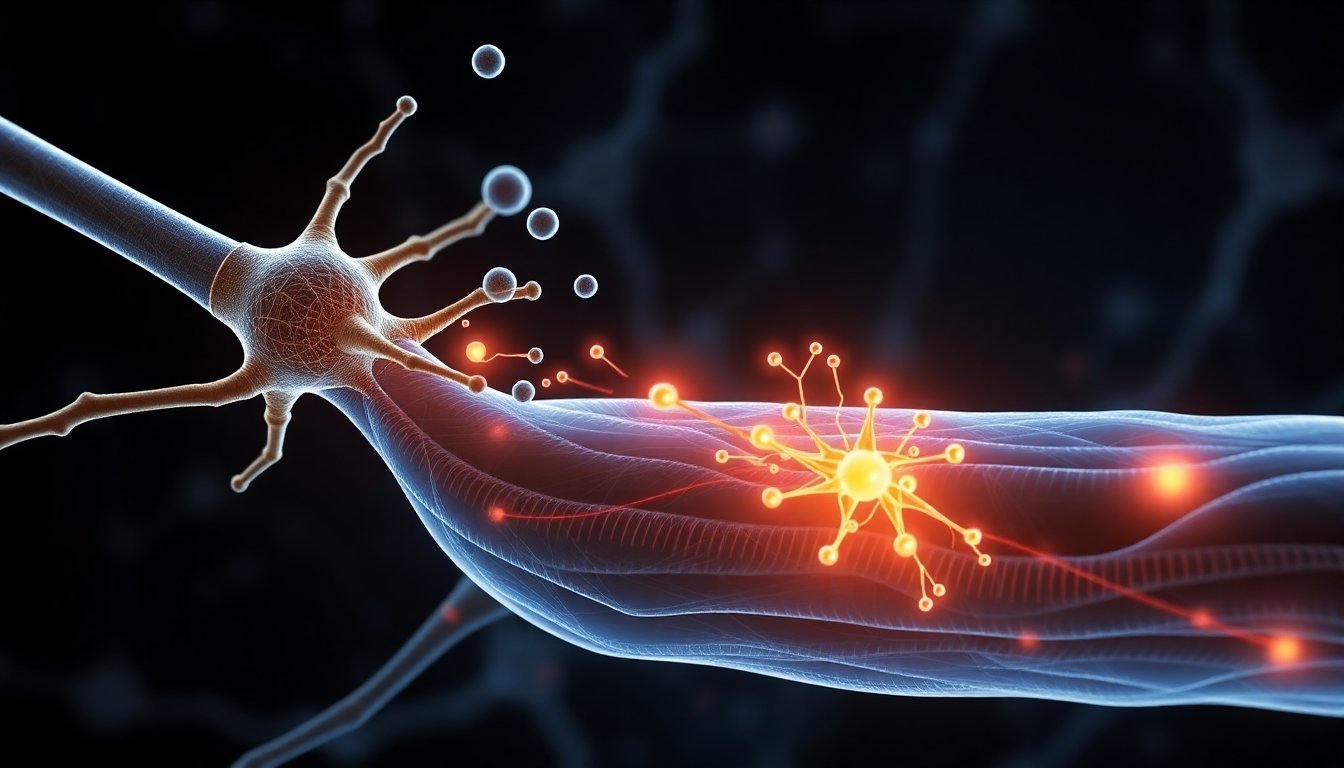
Every move you make, from the blink of an eye to a powerful sprint, is the result of a perfectly orchestrated conversation between your nerves and muscles. This dialogue happens at a specialized location called the neuromuscular junction, a synapse where motor neurons release chemical messengers to command muscle fibers into action. For decades, scientists believed they understood the fundamentals of this lightning-fast exchange. A new study, however, has just revealed a crucial, previously unseen step in the process, fundamentally changing our understanding of how we move.
An international team of researchers, led by Dr. John Baenziger at the University of Ottawa’s Faculty of Medicine, has mapped this nerve-muscle communication on a millisecond-by-millisecond basis. Their findings, published in the prestigious journal Science, overturn a long-held scientific model and introduce a new concept: a ‘primed’ state that prepares the muscle to receive a signal.
The Old Dogma: A Synchronized Symphony
For more than half a century, the prevailing theory of muscle activation was known as the “concerted conformational transition.” The central player in this process is a protein called the nicotinic acetylcholine receptor (nAChR). These receptors sit on the surface of muscle cells, acting as gatekeepers. When a neurotransmitter like acetylcholine arrives from a nerve, it binds to the receptor, causing the gate to open and allow ions to flow into the muscle cell, triggering a contraction.
The concerted model proposed that all parts of this complex receptor protein moved together in perfect unison. Imagine a team of rowers in a boat, all pulling their oars through the water at the exact same moment to propel the boat forward. Scientists believed the receptor’s subunits all shifted from a resting to an active state simultaneously. This framework was the basis for understanding not only normal function but also how diseases and drugs could affect the process.

A Technological Leap Reveals the Truth
The long-standing assumption persisted largely because technology couldn’t capture the process in sufficient detail. Dr. Baenziger’s team, however, leveraged cutting-edge single-molecule imaging techniques. This allowed them to essentially create an atomic-resolution movie of the nAChR as it transitioned from resting to active. What they saw was not a synchronized symphony, but a more complex, staggered dance.
This high-definition view revealed that the components of the receptor do not move together. Instead, they move asynchronously—some parts move first, while others follow. This discovery was so profound that Dr. Baenziger stated the old model was “absolutely not true.” The synchronized symphony was a myth; the reality was far more intricate.
The Discovery: A ‘Primed’ Intermediate State
The team’s most significant finding was the identification of a missing link in the activation pathway: an intermediate “primed” state. They observed that when a single neurotransmitter molecule binds to one of the receptor’s sites, it doesn’t immediately throw the entire gate open. Instead, it causes just one part of the receptor—a single subunit—to transition into an active-like conformation.
The rest of the receptor remains closed but is now “primed” and poised for activation. It’s like a sprinter in the starting blocks, tensed and ready to explode into motion the moment the starting gun fires. This primed state ensures the receptor is ready to respond with maximum efficiency when the second neurotransmitter molecule arrives to fully open the channel.
“This new intermediate structure, called a primed state, is extremely important because it plays a critical role shaping neuromuscular communication,” explains Dr. Baenziger. “Our study provides the first glimpse into this key intermediate along the activation pathway.”
From Muscles to the Brain: Broader Implications
The importance of this discovery extends far beyond the neuromuscular junction. The nicotinic acetylcholine receptor is a member of a vast superfamily of proteins known as pentameric ligand-gated ion channels. Similar receptors are found throughout the central nervous system, playing critical roles in learning, memory, and attention. The principles of asynchronous movement and priming discovered in the muscle receptor likely apply to its cousins in the brain.
As Dr. Baenziger notes, this “new insight impacts broadly on our understanding of communication at neuronal synapses.” By refining our fundamental knowledge of how these crucial proteins work, we can begin to unravel deeper mysteries of brain function and dysfunction.
Paving the Way for Precision Medicine
Beyond rewriting textbooks, this new, more detailed model has profound therapeutic potential. Many debilitating conditions, such as congenital myasthenic syndrome, are caused by genetic mutations that impair the function of these receptors. Previously, scientists trying to design drugs to correct these issues were working with an incomplete blueprint.
With a precise, step-by-step understanding of the activation pathway, including the primed state, researchers can now see exactly how a specific mutation disrupts the process. This allows for the rational design of new drugs that can target the receptor with much greater precision. Instead of a one-size-fits-all approach, therapeutics could be developed to correct the specific mechanical flaw caused by a mutation, whether it’s a problem with initial binding, priming, or full activation.
Dr. Baenziger’s team is already planning its next steps. They intend to use these new structures as templates to study receptors with disease-causing mutations and observe how they respond to different drugs. “We will want to use these new structures as templates to design better therapeutics,” he says. This work, a collaboration involving researchers like lead author Dr. Mackenzie Thompson and scientists in Grenoble, France, represents a major step toward a new era of targeted treatments for neuromuscular and neurodegenerative disorders.
Reference
Thompson, M. G., Zarkadas, E., daCosta, C. J. B., Nury, H., & Baenziger, J. E. (2023). Asynchronous subunit transitions prime acetylcholine receptor activation. Science, 382(6677). https://doi.org/10.1126/science.adj8502