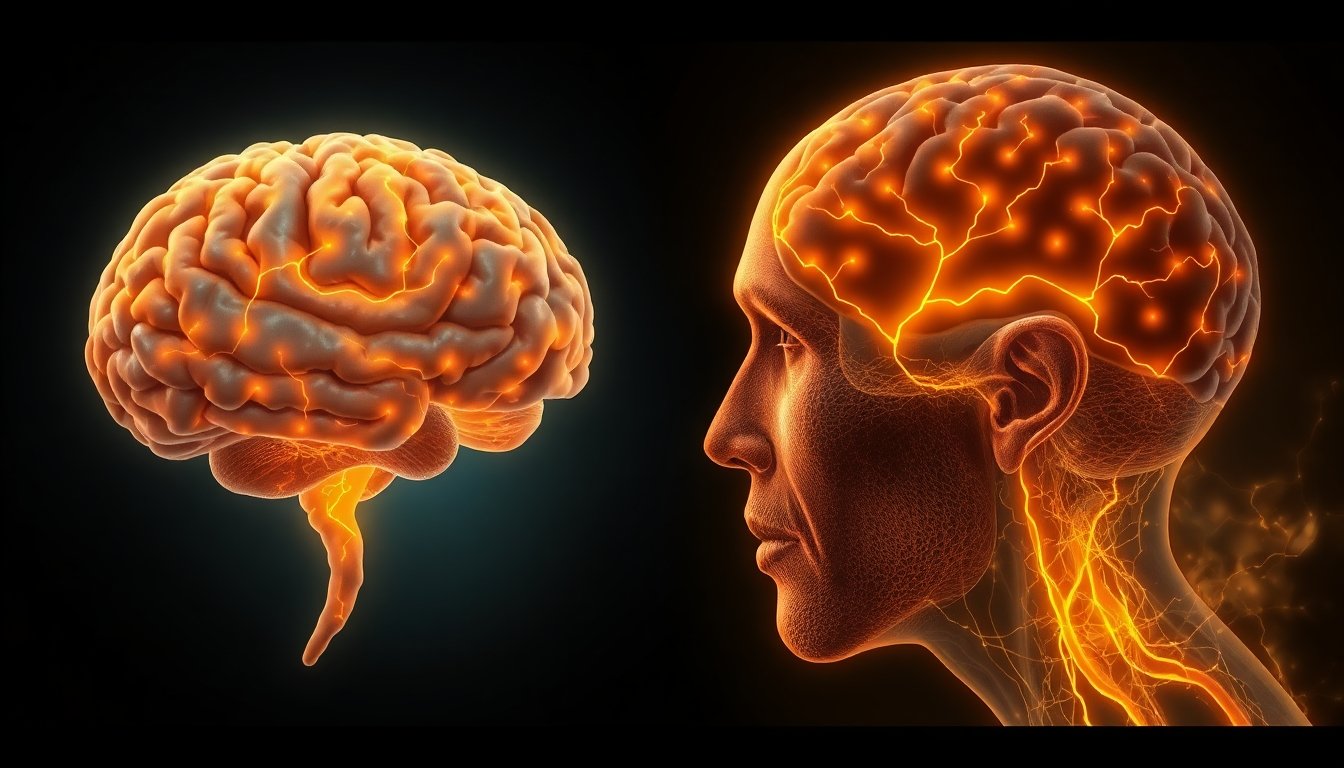
New research suggests that a single genetic mutation protected our ancestors from the brain-damaging effects of lead, a toxin they encountered far earlier than we knew, potentially unlocking our unique capacity for complex language.
What truly separates us from our ancient relatives, the Neanderthals? For decades, scientists have pointed to our complex cultures, sophisticated tools, and, above all, our unparalleled ability to communicate through language. But the biological origins of this cognitive gulf have remained one of the great mysteries of human evolution. Now, a groundbreaking study from the University of California San Diego School of Medicine offers a startling new piece of the puzzle, suggesting that our evolutionary path was shaped not just by our genes, but by our interaction with a potent environmental toxin: lead.

An Ancient Contaminant
We tend to think of lead poisoning as a relatively modern problem, a specter haunting Roman aqueducts and the industrial smog of the 20th century. It was only after we recognized its profound toxicity, particularly to the developing brain, that we began removing it from our gasoline and paint. But the new research, published in Science Advances, reveals that our ancestors’ history with lead is far deeper and more ancient than ever imagined.
An international team of researchers analyzed the fossilized teeth of 51 different hominids from across Africa, Asia, and Europe. The samples spanned a vast evolutionary timeline, including early human ancestors like Australopithecus africanus, extinct great apes like Gigantopithecus blacki, and our closer relatives, the Neanderthals. The results were astonishing. Traces of lead were found in nearly three-quarters of all fossils studied. The highest levels of acute exposure were discovered in a G. blacki fossil dating back a staggering 1.8 million years.
“We stopped using lead in our daily lives when we realized how toxic it is, but nobody had ever studied lead in prehistory,” explains corresponding author Dr. Alysson Muotri. The team speculates that early hominids may have been exposed through contaminated water sources, perhaps seeking out caves with running water, which naturally contain lead deposits. The analysis of tooth enamel showed this exposure began in early infancy, a critical period for brain development.
A Tiny Genetic Shield
This discovery presented a profound question: If our ancestors were constantly exposed to a powerful neurotoxin, how did modern humans manage to thrive and develop such complex cognitive abilities? The answer, it seems, lies in a tiny genetic tweak.
The gene in question is known as NOVA1 (neuro-oncological ventral antigen 1). It acts as a master regulator in the brain, orchestrating the development of neurons and the formation of synapses. It turns out that virtually all modern humans carry a version of the NOVA1 gene that differs from the one found in Neanderthals and other archaic hominids by just a single DNA base pair.
In previous work, Dr. Muotri’s lab had already shown that this single change has dramatic consequences. Using brain organoids—miniature, lab-grown brain models—they found that swapping the modern NOVA1 gene for the archaic version resulted in brains that matured faster but were ultimately less complex. “If all humans have this newer mutation in all corners of the world, very strong genetic pressure must have selected for it in our species,” Muotri notes. The new study set out to test if lead exposure was that pressure.
Mini-Brains Reveal a Language Link
To investigate the connection, the researchers grew two sets of brain organoids. One set contained the modern human NOVA1 gene, and the other contained the archaic, Neanderthal-like version. They then exposed both sets to lead.
Lead exposure altered the activity of the NOVA1 gene in both types of organoids, affecting a host of other genes linked to neurological conditions like autism and epilepsy. But there was one critical difference. Only in the organoids with the archaic NOVA1 variant did lead exposure disrupt the activity of FOXP2, a gene famously linked to speech and language. Humans with mutations in FOXP2 often have severe difficulties forming complex words and sentences.
“These type of neurons related to complex language are susceptible to death in the archaic version of NOVA1,” Muotri states. This suggests that while Neanderthals possessed the same FOXP2 gene as us, their brains may have been uniquely vulnerable to lead’s toxic effects, specifically in the neural circuits essential for language. The modern human NOVA1 variant, in contrast, appears to have shielded these crucial pathways from harm.
The Power of a Protected Brain
The implications of this finding are immense. It suggests that the modern NOVA1 mutation conferred a powerful evolutionary advantage. In a world where lead was a persistent environmental threat, this genetic shield may have allowed Homo sapiens to develop the complex language skills that our relatives could not. This wasn’t just an upgrade; it was a game-changer.
“Language is such an important advantage, it’s transformational, it is our superpower,” says Muotri. With complex language, we could organize complex social structures, share abstract ideas, coordinate large-scale movements, and build cumulative cultures. Neanderthals, while intelligent, may have lacked this efficient communication system, potentially because their neurological development was subtly hampered by the very environment they lived in. This cognitive edge could have been a decisive factor in the eventual success of modern humans and the decline of Neanderthals around 40,000 years ago.
By untangling the intricate dance between our genes and our ancient environment, this research not only sheds light on what makes us human but also opens new avenues for understanding modern neurological conditions rooted in language and development. It’s a powerful reminder that sometimes, our greatest strengths are forged in the crucible of the most unexpected challenges.
Reference
Muotri, A., et al. (2025). Ancient lead exposure and the evolution of human-specific NOVA1 and its impact on neurodevelopment. Science Advances, 11(42), eade1234.