Subtitle: A new neuroscience study suggests our cognitive abilities might be optimized with seven distinct senses, challenging the classic five-sense model and offering insights for AI and robotics.
Do you ever find yourself wishing for a sixth sense? What if, for optimal brain power, you actually needed seven? This is the provocative suggestion of a recent study from researchers at Skoltech, who developed a mathematical model linking memory, sensory features, and intelligence. Their findings propose the human brain—or even intelligent systems—might work best when each concept or memory is characterized by seven distinct features, or in a broader sense, seven “senses.”

Rethinking the Five Senses: The Case for Seven
For centuries, it’s been common knowledge that humans have five primary senses: sight, hearing, touch, taste, and smell. But this new research, published in Scientific Reports by Professor Nikolay Brilliantov and his team at Skoltech, suggests that in terms of memory and information processing, five might simply not be enough.
What led to this eyebrow-raising speculation? The scientists began with a deep dive into the workings of memory—specifically, by building on more than a century of attempts to model the basic units of memory, known as “engrams.” Engrams are essentially collections of neurons scattered throughout the brain that activate together to encode a memory or concept.
Mapping Concepts in the Brain
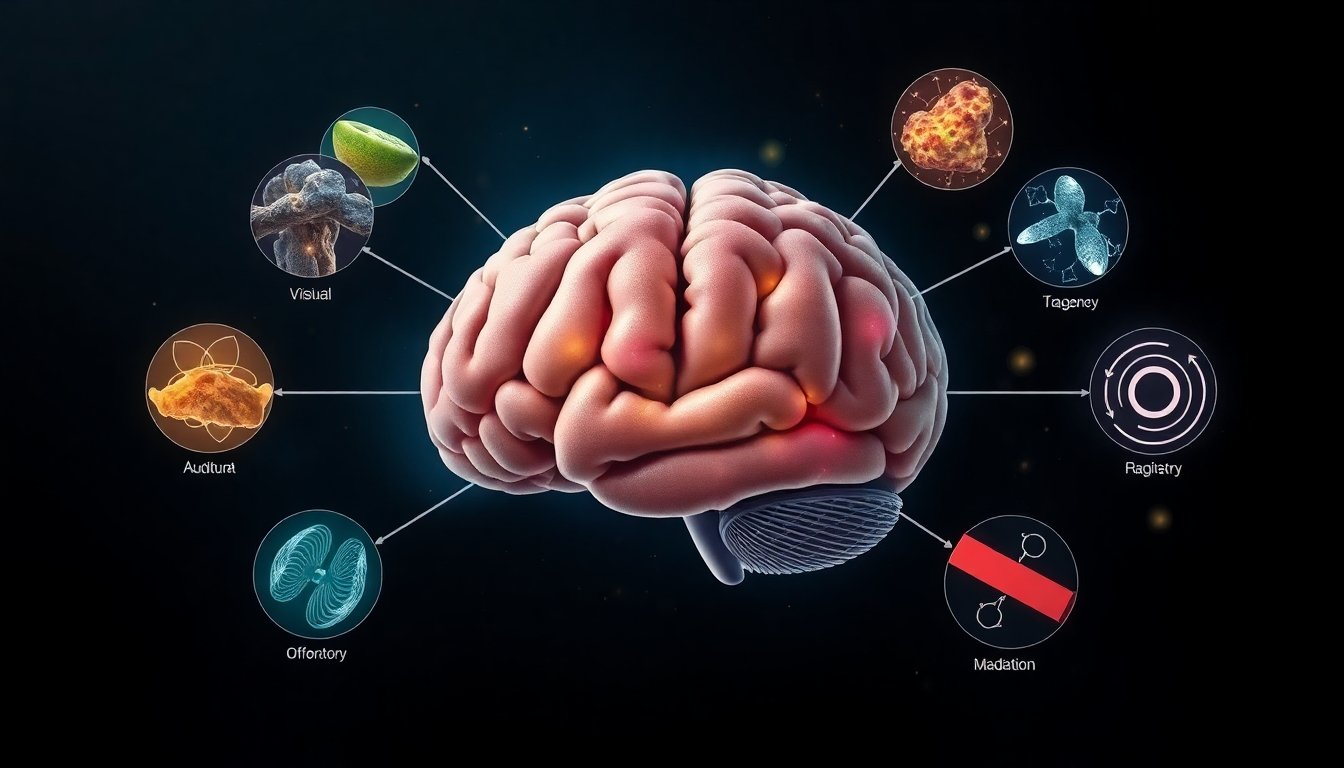
To visualize how the brain represents information, the researchers picture each concept as occupying a spot in a multi-dimensional “conceptual space.” In humans, each of the five classic senses adds a dimension: color and shape (sight), sound (hearing), scent (smell), flavor (taste), and texture (touch). A banana—yellow, curved, soft, sweet, and with a distinctive aroma—would occupy a five-dimensional position in this space.
However, the new Skoltech model allowed these mental objects to have any number of defining features, not just five. Through a series of mathematical simulations, the team discovered a striking pattern: when every concept in memory is described using seven features (rather than just five, or even eight), the number of distinct concepts the brain—or any memory system—can store reaches its maximum. In other words, the brain’s conceptual space appears optimized when it stretches over seven dimensions.
The Mathematics of Memory
So, why seven? The researchers showed that, as engrams evolve over time—being strengthened or faded by repeated stimulation from the senses—they tend to settle into a stable (“steady”) pattern. At this steady-state, the mental system fits the greatest amount of distinct memories or concepts when each is described by seven features.
According to Professor Brilliantov, this result holds true regardless of the specifics of the memory system or the stimuli involved. The model was robust: no matter how you sliced the data, seven kept bubbling up as the optimum.
"Our conclusion is of course highly speculative in application to human senses," Brilliantov admits, "although you never know: It could be that humans of the future would evolve a sense of radiation or a magnetic field. But for now, our findings may be of practical importance for robotics and the theory of artificial intelligence."
Could Humans Evolve More Senses?
The researchers acknowledge that their idea of the ideal number of senses is theoretical—at least as far as biological evolution is concerned. But they point out that the human sensorium, while usually numbered at five, is already a bit blurry. Some neuroscientists argue we have more than five senses, including things like balance (the vestibular sense) or the ability to detect changes in temperature. Some animals already sense magnetic fields; others are sensitive to radiation.
The real intrigue, however, is what these results mean for artificial intelligence and the design of robots. By organizing information input into seven distinct categories, memory capacity and the ability to distinguish among different objects or concepts could be maximized. This could provide a practical blueprint for computing engineers looking to mimic human intelligence, or even outdo it.
Bridging Mind and Machine
Memory remains one of neuroscience’s great mysteries—deeply linked to consciousness and learning. As theoretical models like the one from Skoltech evolve, they give us new ways to understand not just how we remember, but what true intelligence might require, whether inside a skull or a silicon chip.
"Advancing the theoretical models of memory will be instrumental to gaining new insights into the human mind and recreating humanlike memory in AI agents," Brilliantov said. This new mathematical link between memory, senses, and intelligence offers a bold new direction for research—one where the magic number might not be five, but seven.
Reference:
Brilliantov, N., et al. (2024). "Optimal Dimensionality of Concept Space and Memory Capacity: Mathematical Model and Implications." Scientific Reports. Retrieved from https://www.sciencedaily.com/releases/2025/10/251008030955.htm