A groundbreaking study reveals a method to generate text descriptions directly from visual and memory-related brain activity, bypassing the brain’s language centers and opening revolutionary new doors for communication.
Imagine watching a silent film, not on a screen, but entirely within the theater of your mind. You recall a vivid scene: a dog joyfully chasing a red ball across a sunny park. Now, what if a machine could tap into that purely visual thought and write it down in a perfect, coherent sentence? This isn’t the plot of a new sci-fi blockbuster; it’s the stunning reality unveiled by a new brain decoding method called "mind captioning."
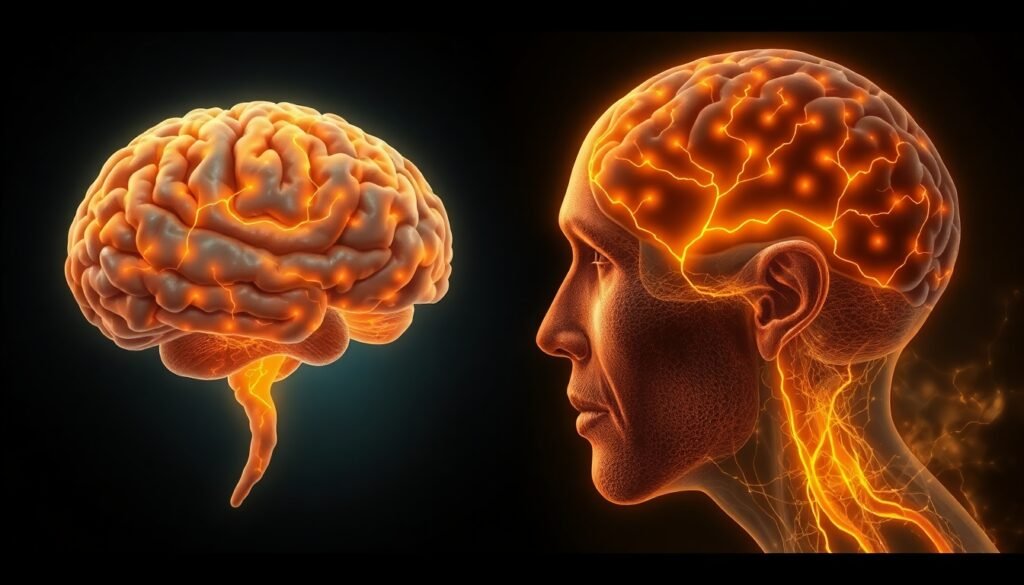
A groundbreaking study has successfully translated the complex, nonverbal content of human thought into structured text. This new system doesn’t listen in on your inner monologue or decode the parts of the brain responsible for speech. Instead, it taps directly into the visual and associative areas, capturing the very essence of what we see or remember, and uses sophisticated AI to weave that meaning into words.
A New Blueprint for Brain-to-Text
For years, the quest to decode thoughts into language has focused on the brain’s language network—the frontal and temporal regions that light up when we think in words, plan to speak, or listen to others. While promising, this approach has a significant limitation: it’s of little use to individuals whose language capabilities are impaired, such as those with aphasia from a stroke or degenerative conditions like ALS.
Mind captioning charts a fundamentally different course. It sidesteps the language centers entirely. The research team, using functional MRI (fMRI) to monitor brain activity, had participants watch short video clips. The system’s goal was not to find word-related signals, but to decode the rich tapestry of semantic information—the underlying meaning—encoded across the entire brain as it processed these visual scenes.
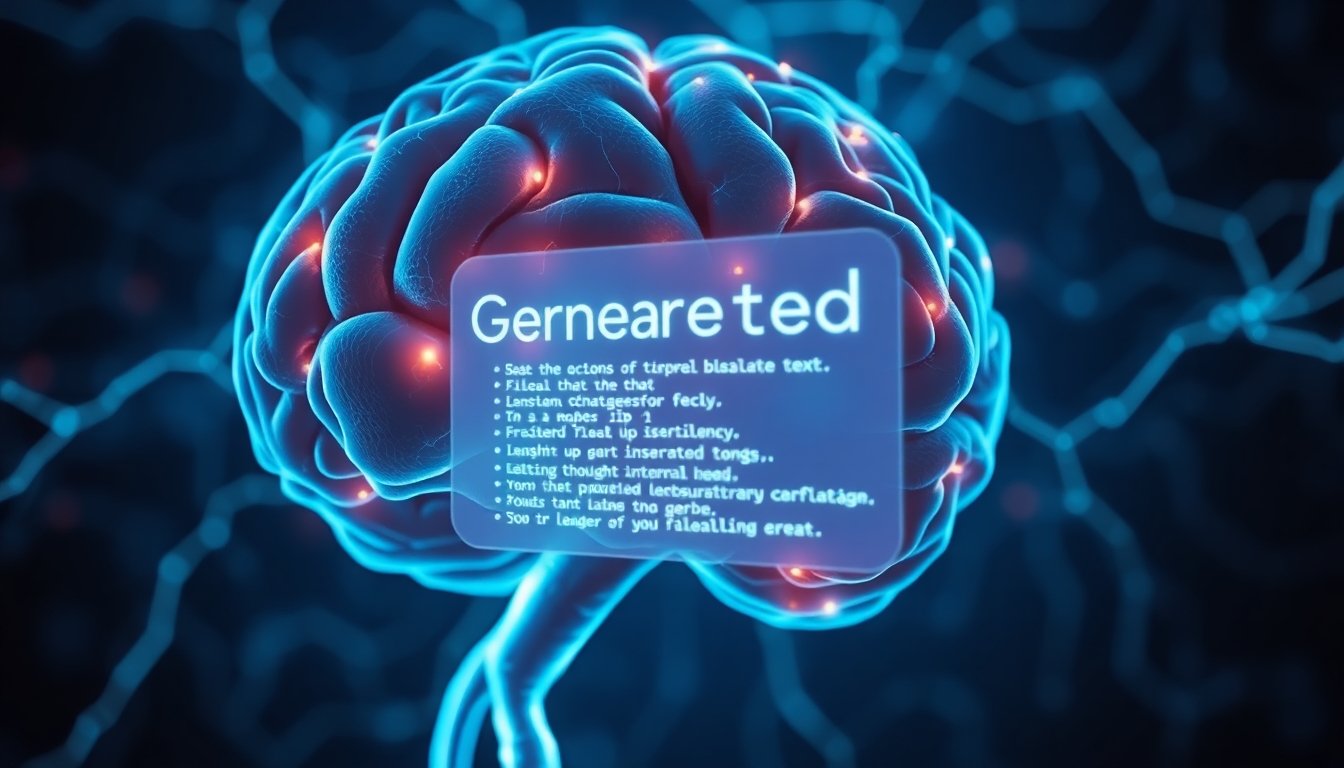
The process is a brilliant fusion of neuroscience and artificial intelligence. First, a linear decoder translates the raw fMRI data into a set of "semantic features." These features, extracted from a powerful deep language model, represent the contextual meaning of concepts and their relationships. Think of them not as words, but as the abstract ingredients of meaning. Then, through a process of iterative optimization, a second AI model works to construct a sentence. It starts with a blank slate and gradually refines word choices, constantly checking to see how well the evolving sentence’s semantic meaning aligns with the features decoded from the brain. It’s like a sculptor carefully chipping away at a block of marble to reveal the form hidden within.

Decoding Memories and Structured Thought
One of the most astonishing findings from the study is that mind captioning works not only on what a person is actively watching but also on what they are merely remembering. Participants were asked to recall a video they had previously seen, and the system was still able to generate accurate text descriptions from their brain activity alone. The accuracy was remarkable; in some cases, the system could identify which specific video was being recalled out of 100 possibilities with nearly 40% accuracy, where pure chance would be just 1%.
Crucially, this was achieved without relying on the brain’s language centers. When the researchers intentionally excluded these regions from their analysis, the system’s performance only dropped slightly. This provides compelling evidence that our brains encode complex, structured information—about objects, actions, and the relationships between them—in areas far beyond those dedicated to speech.
This speaks to another critical breakthrough: the system generates structured meaning, not just a jumble of keywords. It can distinguish between "a dog chasing a ball" and "a ball chasing a dog." When the researchers tested this by shuffling the word order in the generated sentences, the system’s ability to match them to the correct brain activity plummeted. This proves that the decoder isn’t just identifying objects; it’s capturing the high-level, relational narrative that forms the basis of coherent thought.
A Future Voice for the Voiceless
The implications of this research are profound, particularly for the field of assistive communication. By creating a pathway from nonverbal thought to text, mind captioning could one day provide a voice for individuals with severe communication impairments. People with locked-in syndrome, severe aphasia, or advanced motor neuron disease, who are unable to speak or type, might be able to communicate their thoughts, needs, and experiences to the world.
Because the system is built on decoding universal visual and semantic representations rather than language-specific signals, it holds the potential to be adapted across different native languages. It could even offer a future window into the mental experiences of those who cannot yet speak, such as pre-verbal infants, or perhaps even non-human animals.
The Road Ahead: Promise and Precaution
Of course, the technology is still in its early stages. The current method relies on bulky and expensive fMRI machines and requires intensive data collection to train the decoders for each individual. However, as brain-sensing technology and AI algorithms continue to advance, future iterations may become more portable, less invasive, and easier to implement.
This rapid progress also brings with it a host of critical ethical questions. The ability to decode a person’s inner visual world raises serious concerns about mental privacy and consent. As these tools become more powerful, establishing robust ethical safeguards will be paramount to ensure they are used to empower, not exploit.
Even with these challenges, the core achievement of mind captioning is undeniable. It has fundamentally reframed what is possible in brain decoding, proving that we can translate the rich meaning of our thoughts into language without ever speaking a word. This leap forward doesn’t just inch us closer to more advanced brain-machine interfaces; it reshapes our very understanding of the relationship between thought, meaning, and the mind itself.
Reference
Horikawa, T. (2023). Mind captioning: Evolving descriptive text of mental content from human brain activity. Science Advances, 9(49), eadj0478. https://doi.org/10.1126/sciadv.adj0478