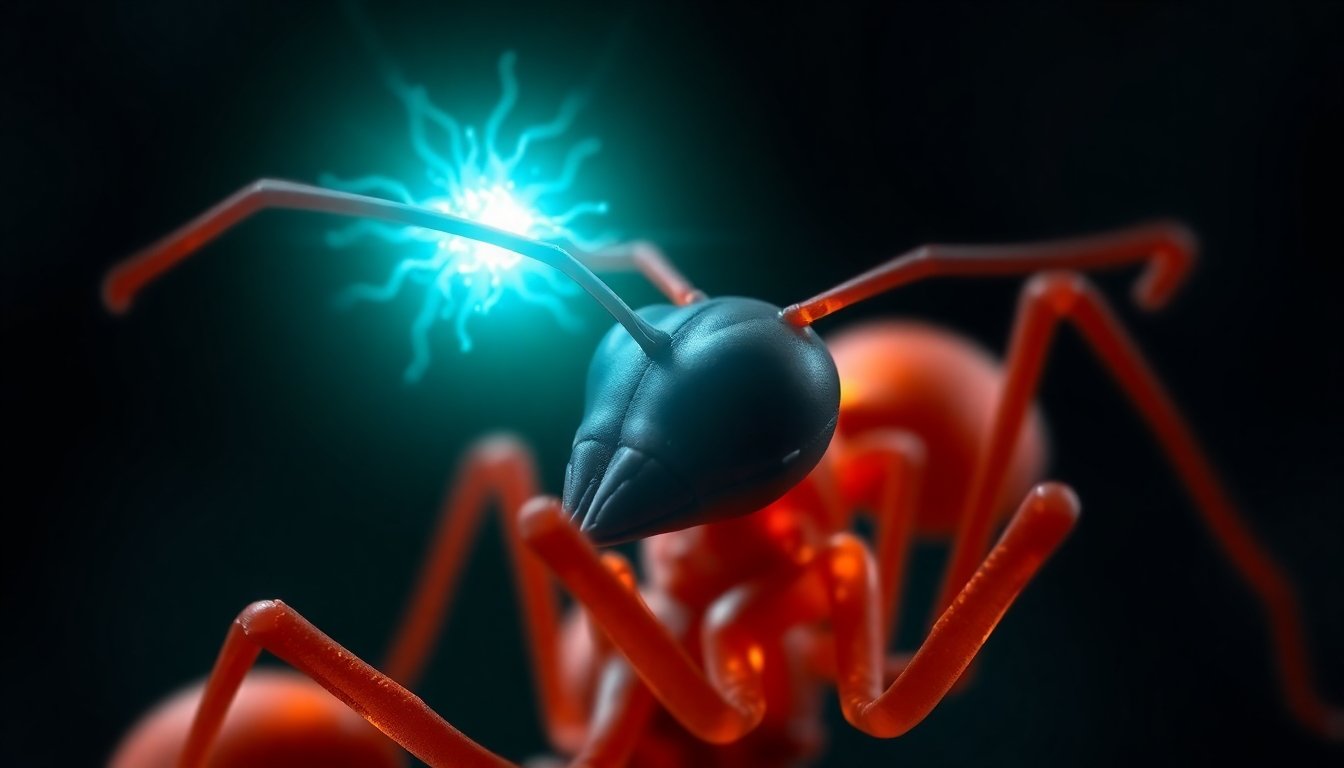
Neuroscientists have uncovered a remarkable new form of gene regulation in ants, a ‘protective shield’ that allows each sensory neuron to focus on a single scent, solving a long-standing puzzle in insect biology.
Ant societies are marvels of chemical communication. An intricate language of pheromones, invisible to us, dictates nearly every aspect of their lives, from finding food and identifying kin to sounding the alarm against predators. This entire system hinges on an incredibly precise sense of smell, governed by a strict biological principle: one neuron, one receptor. While an ant’s genome contains a vast library of hundreds of odorant receptor genes, each sensory neuron in its antenna must express only one. If a neuron were to express multiple receptors, the signals sent to the brain would become a scrambled, meaningless mess, and the colony’s delicate social fabric would unravel.
For decades, scientists have understood this “one receptor, one neuron” rule, but how ants achieve this incredible feat of genetic precision has remained a mystery. Now, a team of researchers at Rockefeller University, led by Daniel Kronauer, has finally cracked the code. Their findings, published in Current Biology, reveal a unique and elegant mechanism that is fundamentally different from those seen in other well-studied animals like fruit flies or even mammals.
A Puzzle of Scale and Complexity
The challenge of selecting a single receptor is a universal problem in sensory neuroscience. As graduate student Giacomo Glotzer of the Kronauer lab puts it, “It’s a kind of dogma in the field of sensory neuroscience. Each sensory neuron typically expresses one receptor—and that gives it its identity.”
Different species have evolved different solutions. The humble fruit fly, with its relatively simple olfactory system of about 60 receptors, uses a system of molecular switches that neatly turn individual genes on or off. Mammals, on the other hand, which possess hundreds of receptor genes like ants, employ a more chaotic strategy. Their neurons randomly reshuffle their DNA packaging, or chromatin, until only one receptor gene is left accessible and all others are locked away.
Ants presented a conundrum. They have a mammalian-scale repertoire of several hundred odorant receptors, many of which are packed tightly together in clusters of nearly identical genes. In such a crowded genetic neighborhood, a simple on/off switch like the fruit fly’s would risk accidentally activating adjacent genes. This suggested that ants must have their own, undiscovered strategy for maintaining olfactory clarity.
A Protective Bubble of Genetic Interference
To uncover this mechanism, the Rockefeller team turned to the clonal raider ant, an ideal model organism for genetic studies. Using a suite of cutting-edge molecular and computational techniques, including RNA sequencing and RNA fluorescence in situ hybridization, they were able to visualize gene activity directly within the ant’s antennal tissue. What they found was not a simple switch or a chaotic reshuffling, but a sophisticated process they call “transcriptional interference.”
Here’s how it works: When an ant neuron commits to expressing one specific odorant receptor gene, the cellular machinery responsible for transcribing DNA into RNA—the RNA polymerase—goes into overdrive. Instead of stopping at the designated endpoint of the chosen gene, it continues right on past it, plowing through the neighboring genes downstream. This process generates long, garbled “readthrough” transcripts that, according to the researchers, are likely non-functional and remain trapped in the nucleus. Their very production, however, physically interferes with and silences the downstream genes.
But the mechanism is even more clever. The neuron also initiates transcription in the opposite direction from the chosen gene. These “antisense” RNAs act as a roadblock, preventing the activation of any upstream genes in the cluster. The combined effect of this downstream spillover and upstream blockade creates what the scientists describe as a “protective genetic shield” or a molecular bubble around the single chosen receptor.
“Our findings center around transcriptional interference—that the neuron chooses one receptor by preventing the true transcription of other receptors both upstream and downstream,” explains Parviz Daniel Hejazi Pastor, a biomedical fellow in the lab. This active silencing of the local genomic environment ensures that the neuron can dedicate itself to a singular olfactory identity.

Beyond the Ant Colony
The discovery of this elegant system has implications that reach far beyond the world of ants. The research team confirmed that the same mechanism is at play in other social insects, including the Indian jumping ant and the honeybee. This suggests that transcriptional interference may be a widespread strategy among insects, particularly those with large and complex olfactory systems.
“This mechanism may be even more broadly distributed than we thought,” Kronauer notes. “It’s even possible that fruit flies are the odd ones out.”
Furthermore, this work provides a potential blueprint for how genomes can regulate large families of related genes, not just those involved in smell. The two-way safeguard—readthrough silencing downstream genes and antisense blocking upstream ones—is a robust way to manage crowded genetic regions.
This regulatory system also offers a compelling explanation for how ants have been able to so rapidly evolve their complex sense of smell. With this protective shield mechanism in place, new receptor genes can be duplicated and integrated into the genome without disrupting the existing system. There’s no need to co-evolve a new, specific on/off switch for each new gene. “Once you have the system in place like this, you can allow it to become more complex without disrupting anything,” Kronauer speculates. This built-in flexibility may be the key to the evolutionary success and diversity of ants.
The study stands as a powerful testament to the importance of looking beyond conventional model organisms. By focusing on the unique biology of the clonal raider ant, scientists have uncovered a fundamental molecular phenomenon that would have remained hidden in more traditional lab subjects, opening a new chapter in our understanding of gene regulation, sensory neuroscience, and evolution.
Reference
Glotzer, G., Hejazi-Pastor, P. D., et al. (2024). Transcriptional interference by antisense and readthrough transcription enables singular olfactory receptor gene choice in ants. Current Biology.