A groundbreaking study in mice reveals how stimulating or impoverished environments physically alter memory circuits by flipping a crucial genetic switch.
Nature versus nurture is one of science’s oldest debates. We know intuitively that our early experiences shape who we become, but how deep does that influence go? Does a stimulating childhood literally build a better brain? A new study provides a stunningly detailed answer, revealing that our environment doesn’t just influence our behavior—it reaches deep into our neurons to physically rewrite the genetic instructions that govern memory.
A team of neuroscientists sought to map the precise molecular changes that occur in the brain in response to different early-life conditions. Their findings, published in Nature Communications, pinpoint a specific genetic “master switch” that is turned up by stimulating environments and turned down by deprived ones, directly impacting memory function.
Three Worlds, Three Different Brains
The researchers began by creating three distinct worlds for young mice just after weaning. Some were placed in an “enriched environment” (EE), a veritable mouse playground complete with toys, running wheels, and plenty of social interaction. Others were moved to an “impoverished environment” (IE), where they lived in social isolation without any stimulating objects. A control group remained in standard lab cages (SC).
After three months, the cognitive differences were stark. The mice from the enriched environment excelled at a variety of memory tasks. They showed superior spatial learning in a water maze and were better at recognizing novel objects. Crucially, these benefits were long-lasting, persisting even after the mice were moved back to standard cages for a month. In stark contrast, the mice from the impoverished environment struggled, showing significant impairments in their ability to discriminate between new and familiar objects, a sign of poor recognition memory. The message was clear: the early-life environment had a powerful and enduring impact on cognitive ability. But the real question was why.
Diving Deep into the Memory Center
To find the answer, the scientists zoomed in on the hippocampus, the brain’s essential hub for learning and memory. The hippocampus isn’t a uniform block; it’s composed of different types of neurons with highly specialized jobs. The team focused on two key players: CA1 pyramidal neurons and DG granule neurons.
Using a sophisticated “multiomic” analysis, they mapped the entire molecular landscape inside these specific cells. This involved looking at which genes were active (gene expression), how the DNA was packaged and accessible (chromatin), and what chemical tags were present on the DNA (epigenetics). They discovered that the enriched and impoverished conditions were triggering widespread changes in the activity of genes, but they were doing so differently in the two types of neurons.
The AP-1 Master Switch
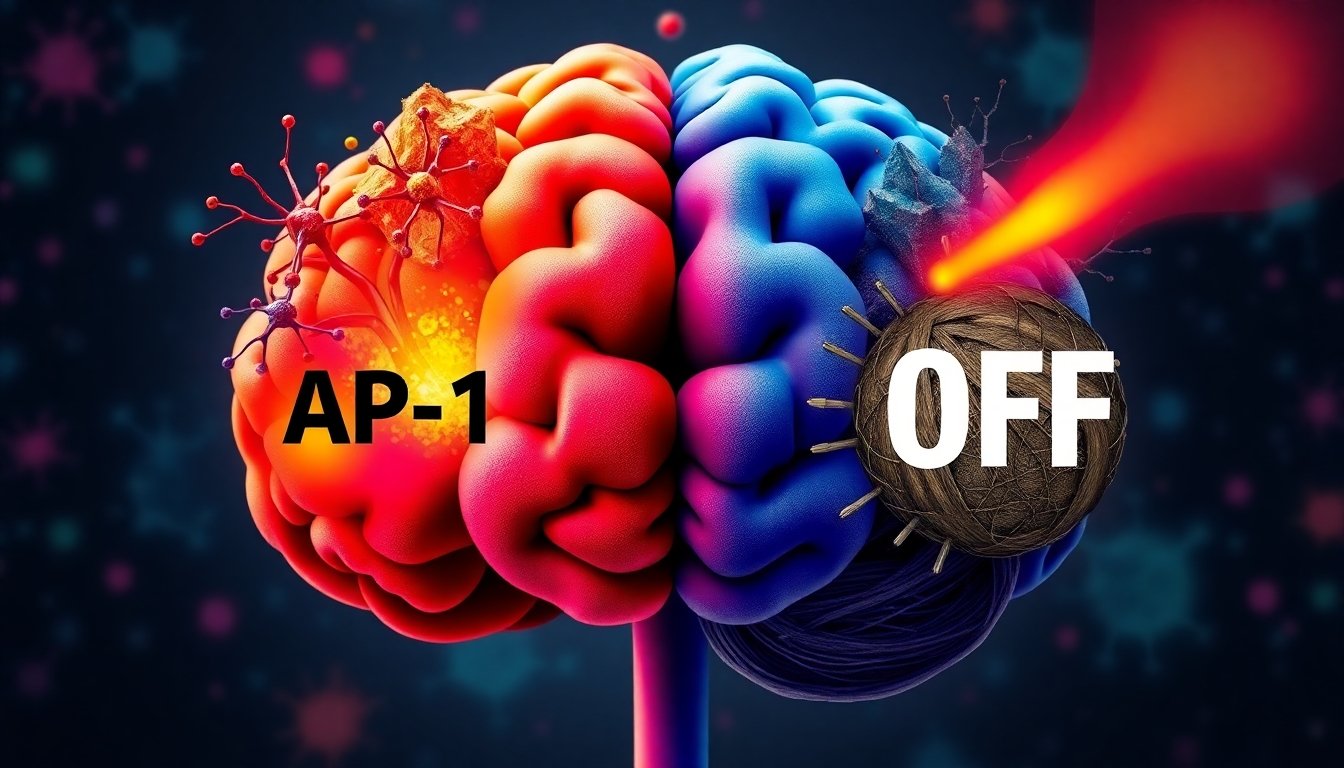
The investigation uncovered a central character in this molecular drama: a protein complex called Activator Protein 1, or AP-1. Think of AP-1 as a master genetic switch. When neurons are active—for instance, when learning something new—AP-1 turns on, binds to DNA, and activates a cascade of genes needed to strengthen synaptic connections and form memories.
The study revealed a remarkable, bidirectional effect on this switch, driven entirely by the environment:
- In the enriched environment, AP-1 activity was significantly boosted, especially in the DG granule neurons. The stimulating world was essentially telling these cells to ramp up their memory-building machinery.
- In the impoverished environment, the exact opposite happened. AP-1 activity was suppressed, particularly in the CA1 pyramidal neurons. The lack of stimulation was turning the switch off, hobbling the cells’ ability to maintain strong memory circuits.
This cell-type-specific effect is a critical insight. It shows that the environment doesn’t just have a blanket effect on the brain; it fine-tunes different parts of the memory circuit in distinct ways. The genes controlled by AP-1 are essential for synaptic function and plasticity, meaning the environment was directly remodeling the brain’s capacity for memory at the most fundamental level.

The Smoking Gun: Proving Causality
To prove that AP-1 was truly the cause and not just a correlation, the team performed a final, elegant experiment. They genetically engineered mice so that a key component of the AP-1 complex, a protein called FOS, could be deleted from their brain’s excitatory neurons. These “knockout” mice were then raised in the same stimulating, enriched environment as the others.
The result was the smoking gun. These mice failed to gain the full cognitive benefits of their enriched upbringing. While they could still learn the basics of a task, their cognitive flexibility and recognition memory were significantly impaired compared to normal mice that had enjoyed the same environment. By removing a key part of the AP-1 switch, the researchers had effectively disconnected the environment from its ability to enhance the brain. This confirmed that the AP-1 pathway is a necessary mediator for the cognitive boons of a stimulating world.
From Nurture to Nature
This research transforms our understanding of how nurture shapes nature. It demonstrates that early-life experiences create lasting changes in cognitive function by physically modulating a specific genetic pathway—the AP-1 signaling cascade—within distinct populations of hippocampal neurons. An enriched environment activates this pathway to bolster the molecular machinery of memory, while an impoverished one suppresses it, leading to cognitive deficits.
These findings provide a concrete molecular basis for the profound importance of a stimulating environment during development. They also open new avenues for understanding and potentially treating cognitive disorders linked to early-life adversity. The debate isn’t just nature or nurture; it’s about how nurture actively and physically sculpts our nature, one neuron at a time.
Reference
Pulido, V. L. V., Conte, G., Scheggia, D., De Rosa, A., Papaleo, F., De Rubeis, S., & Testa, G. (2024). Neuronal type-specific modulation of cognition and AP-1 signaling by early-life rearing conditions. Nature Communications, 15(1), Article 2234. https://doi.org/10.1038/s41467-024-46534-5