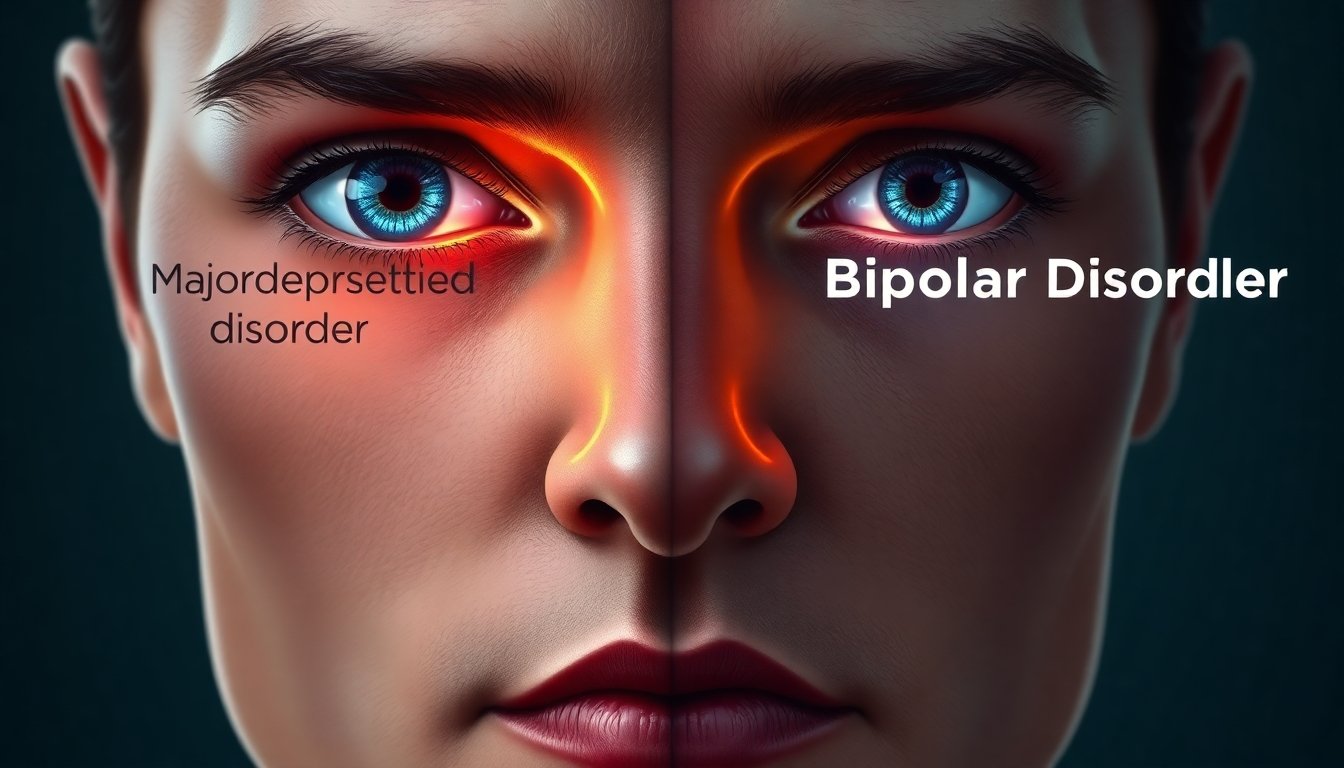
A groundbreaking AI can now distinguish between major depression and bipolar disorder with stunning accuracy, not by what we say, but by the subtle, fleeting movements in our faces.
Diagnosing affective disorders like Major Depressive Disorder (MDD) and Bipolar Disorder (BD) is one of modern psychiatry’s most significant challenges. Their symptoms, particularly during depressive episodes, can appear nearly identical. This clinical overlap leads to a staggering problem: up to half of individuals with bipolar disorder are initially misdiagnosed with major depression. This isn’t just a clerical error; it can lead to treatment delays of eight to ten years, inappropriate medication that can worsen the condition, and immense personal and economic costs. Clinicians rely on structured interviews and patient history, but these methods are subjective and time-consuming. What if there were a more objective, rapid way to see the difference?
Scientists have recently developed a powerful new tool that does just that. It’s a deep-learning model called Emoface, and it’s designed to assist clinicians by identifying unique “facial biomarkers” that differentiate MDD from BD. This AI-assisted solution represents a major leap forward in the quest for precision diagnostics in mental health.
Training an AI to See What Humans Miss
To build Emoface, researchers from Zhejiang University and associated hospitals assembled the largest single-center facial dataset for affective disorders to date. They recorded the facial movements of 353 participants—including individuals diagnosed with MDD, BD, and a healthy control group—as they watched a series of videos designed to elicit specific emotions like happiness, sadness, anger, and fear.
By analyzing hundreds of thousands of video frames, the deep learning model was trained to recognize the complex, often subconscious, facial muscle movements associated with each condition. The system tracks 68 key facial points, divides the face into 16 distinct regions, and analyzes the movement of nine major facial organs (like the eyebrows, eyes, and mouth). This granular level of detail allows the AI to pick up on patterns that are virtually invisible to the naked eye, even that of a trained psychiatrist.
The Telltale Signs in the Eyes and Mouth
So, what did Emoface discover? The model pinpointed specific, consistent differences in how the faces of people with MDD and BD react to emotional stimuli. The most powerful digital biomarkers were found in the movements around the eyes and mouth.
For individuals with Bipolar Disorder, Emoface found that the most significant emotional indicators were concentrated in the outer corners of the eyes. These regions showed much higher activation during emotional responses. The model also placed significant weight on the movement of the eyebrow contours and the outer lip contour, capturing the complex and dynamic expressions often characteristic of BD.
In contrast, for those with Major Depressive Disorder, the diagnostic clues were found elsewhere. Emoface demonstrated a heightened sensitivity to subtle movements in the inner corners of the eyes. While the outer corners were less expressive, the inner eye regions, along with the eyebrow and inner lip contours, provided the key data for an accurate MDD diagnosis.
Healthy individuals, by comparison, showed more evenly distributed activation across all these facial regions, reflecting a more neutral and varied range of natural expressions.

Creating a Digital Blueprint for Diagnosis
The innovation doesn’t stop at just identifying these biomarkers. The research team used Emoface to generate “standard digital facial maps” for both MDD and BD. By averaging the key facial contour and emotional parameters from hundreds of patients, they created 3D digital faces that represent the generalized facial structure and movement patterns typical of each disorder.
These digital avatars serve multiple purposes. In a clinical setting, a new patient’s facial data could be compared to these standard models to aid in diagnosis, offering a quick and scalable solution. This approach also offers a novel way to protect patient privacy, as the diagnostic analysis can be performed on a digital representation rather than the raw video footage. Furthermore, these models can serve as invaluable tools for medical education, helping to train the next generation of psychiatrists to recognize the subtle physical manifestations of these complex conditions.
Real-World Results and Future Promise
When deployed in a real-world clinical setting with 347 new patients, Emoface’s performance was remarkable. Using just the facial video data, the model correctly identified Bipolar Disorder with 95.38% accuracy and Major Depressive Disorder with 85.61% accuracy. When focusing explicitly on the extracted digital biomarkers, the accuracy for MDD classification rose to 87.12%, demonstrating the power of isolating these subtle cues.
These results suggest that an AI-powered analysis of facial movements can serve as a rapid, accessible, and effective supplement to traditional diagnostic methods. In a busy outpatient clinic, a camera could capture a patient’s facial responses during a consultation, and Emoface could provide real-time analysis to the clinician, enhancing their diagnostic accuracy and reducing the likelihood of misdiagnosis.
While the technology is incredibly promising, the researchers acknowledge its current limitations. The model still faces challenges in interpreting complex micro-expressions and requires more data to improve the realism of the digital faces. Crucially, the initial dataset was composed of Han Chinese individuals, and future work must include diverse ethnic and cultural groups, as facial expressions can vary across populations.
Even with these hurdles, Emoface marks a pivotal moment in mental healthcare. It demonstrates that within our most expressive features lies a wealth of objective data. By learning to read this data, AI is paving the way for a future where mental health diagnoses are faster, more accurate, and more accessible for everyone.
Reference
Yu, J., Chen, J., Zhang, Y., Lyu, H., Ma, T., Huang, H., Wang, Z., Xu, X., Hu, S., & Xu, Y. (2025). Emoface: AI-assisted diagnostic model for differentiating major depressive disorder and bipolar disorder via facial biomarkers. Communications Medicine, 5(1), 164. https://doi.org/10.1038/s44184-025-00164-4