A new study reveals the surprising flexibility of our internal navigation system, showing how it tracks our position even when its classic map seems to disappear.
Imagine waking up in the middle of the night in an unfamiliar hotel room. It’s pitch black. You need a glass of water, and you remember seeing the kitchen before you went to bed. Without any visual cues, you rely on an internal sense of movement—a few steps forward, a slight turn right—to navigate the space. This remarkable ability is called path integration, and it’s the brain’s way of keeping track of your position based purely on your own motion.
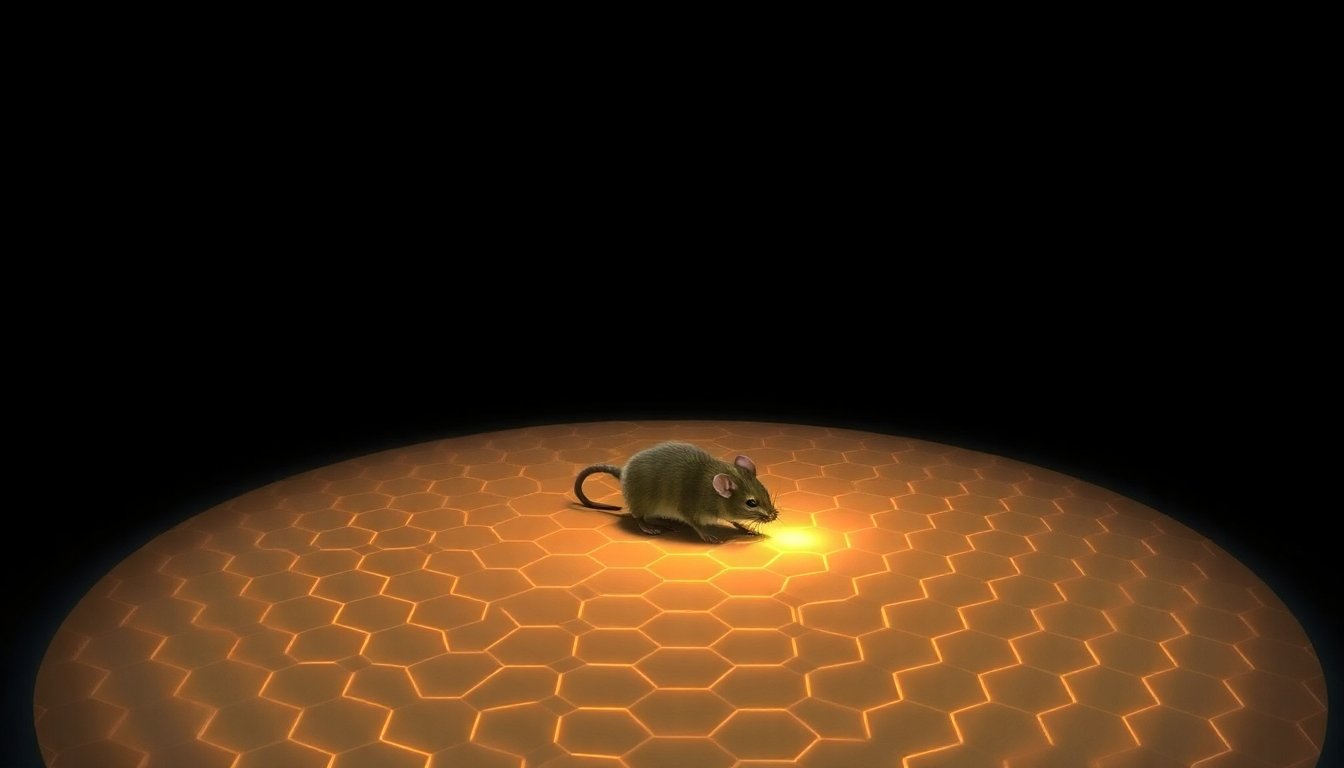
For years, neuroscientists have believed that a special type of neuron, called a “grid cell,” is the star player in this internal GPS. Found in a brain region called the medial entorhinal cortex, these cells fire in a stunningly regular, hexagonal pattern as an animal explores its environment. This creates a coordinate system, a kind of neural graph paper, upon which the brain can map its location. But what happens to this pristine grid when the lights go out, and the brain must rely solely on path integration? A groundbreaking study published in Nature Neuroscience decided to find out, and their discoveries challenge what we thought we knew about how our brains navigate.
A Homing Challenge in the Dark
To isolate path integration, researchers designed a clever task for mice called the AutoPI homing task. A mouse would start in a “home base,” venture out into a circular arena to find and press a randomly placed lever, and then return home to collect a food reward. The scientists monitored the activity of grid cells throughout this process.
The key twist was that the mice performed this task in both light and complete darkness. In the light, they could use visual landmarks to find their way. But in the dark, they were forced to rely on path integration. As expected, their journey home was less direct in the dark, and the longer they had to search for the lever, the larger their homing error became. This confirmed they were using an internal system that, like a ship navigating by dead reckoning, accumulates small errors over time.
The Mystery of the Vanishing Grid
When the researchers looked at the grid cell activity, they were met with a surprise. The beautiful, stable, hexagonal firing patterns that are the hallmark of grid cells during random foraging seemed to vanish during the homing task. The neat, geometric map had dissolved into what looked like disorganized activity. This posed a critical question: If the grid was gone, how were the mice still able to navigate, even with some error?
This is where the team had to dig deeper. They hypothesized that even if the activity of individual cells looked messy, the relationships between the cells might be preserved. Think of it like an orchestra. During a structured symphony (random foraging), each musician’s part is clear and periodic. But during a more improvisational piece (the homing task), the individual melodies might seem chaotic. However, the musicians are still listening to each other, maintaining their relative timing and harmony. The underlying structure of the ensemble remains.
Using a sophisticated deep-learning model, the scientists proved this was exactly what was happening. Despite the lack of a visible grid pattern, they could accurately decode the mouse’s movement path from the collective activity of the grid cells. The information was still there, just hidden in a more complex code. This demonstrated that grid cells can accurately track movement using self-motion cues alone, even when their classic firing pattern is absent.

A GPS with a Shifting Anchor
The study’s most profound discovery was about how this internal map orients itself. A GPS needs to be anchored to a reference frame—for us, it’s the globe. For the mice, the default anchor was the room itself. But the researchers found something remarkable happened when the mouse reached the lever in the dark.
The entire grid cell system would “reanchor” itself to the lever. The internal map, which had been aligned with the room, suddenly shifted its center to lock onto this new, behaviorally important object. This is a radical idea. It means the brain’s GPS isn’t fixed; it’s flexible, capable of switching its reference frame on the fly from a stable, global environment to a temporary, local landmark. This reanchoring happened through a clean “translation” or shift of the entire map, not a messy rotation, preserving the map’s internal integrity.
How a Drifting Map Leads Us Astray
This reanchoring mechanism also helped solve the final piece of the puzzle: why do we make errors when navigating in the dark? The researchers found that during the long search for the lever in darkness, the orientation of the internal grid map would slowly “drift.” The longer the search, the greater the drift.
And here is the crucial link: this neural drift directly predicted the mouse’s behavioral errors. If the internal map drifted slightly to the left during the search, the mouse would veer to the left on its journey home. For the first time, scientists have drawn a direct line from the moment-to-moment drift of the brain’s cognitive map to the navigational errors an animal makes.
This study fundamentally reshapes our understanding of the brain’s internal GPS. It reveals that grid cells are far more dynamic and flexible than previously imagined. They don’t just maintain a rigid map; they operate as a robust path integrator that can function without its classic grid pattern, dynamically switch its anchor points between global and local reference frames, and whose subtle drifts are the very source of our navigational mistakes when we lose our way in the dark.
Reference
Raunak, P., Le, T. A., Kruse, M. S., Tukker, J. J., Penagos, H., Dasgupta, S., … & Kentros, C. (2024). Grid cells accurately track movement during path integration-based navigation despite switching reference frames. Nature Neuroscience. https://doi.org/10.1038/s41593-024-01654-6