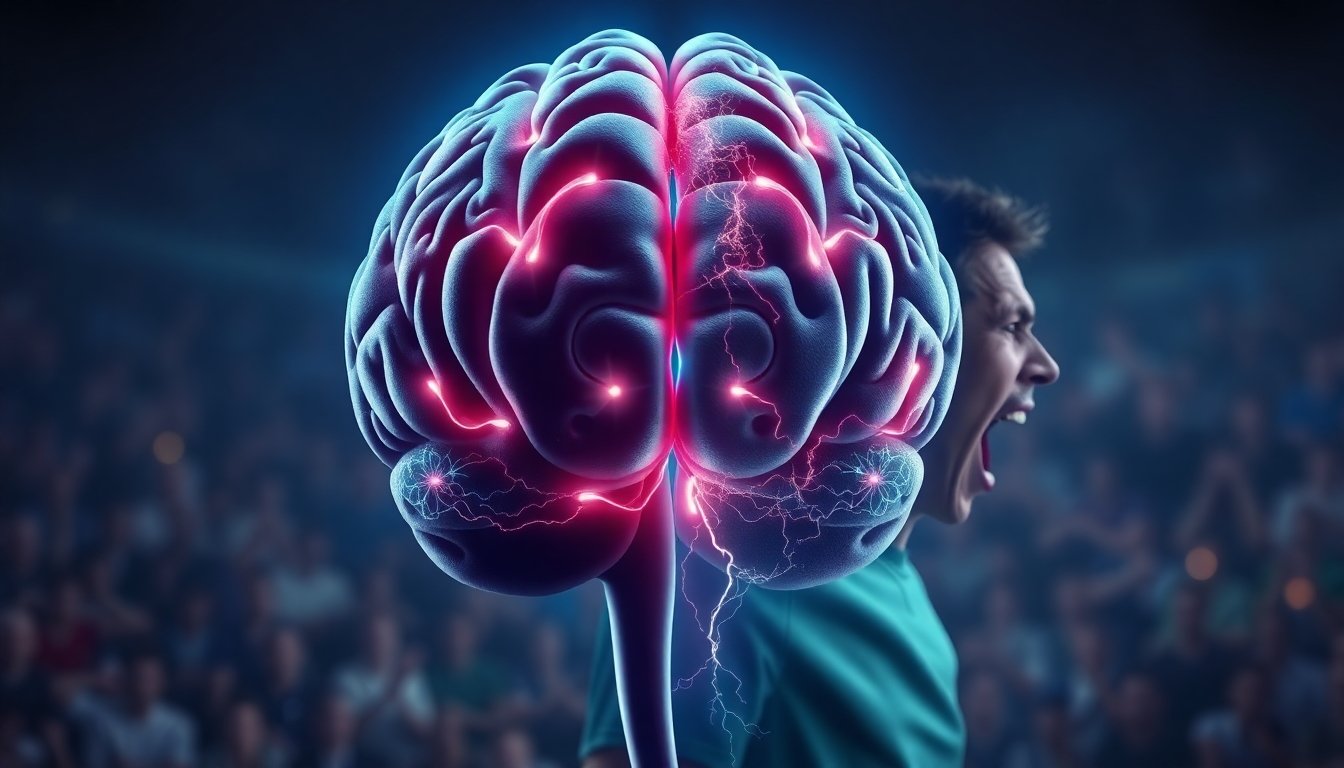
New brain imaging research on soccer fans reveals how a single moment in a high-stakes game can amplify our reward circuits while simultaneously shutting down our emotional control center, explaining why even the most rational people can "flip" in an instant.
It’s a feeling every passionate sports fan knows. The seconds are ticking down in a crucial match against your fiercest rival. Your team scores. The world explodes in a euphoric rush of pure joy. Now, imagine the opposite: the rival team scores, and a wave of white-hot anger or crushing despair washes over you. In these moments, rational thought seems to vanish, replaced by raw, overwhelming emotion. Have you ever wondered what’s actually happening inside your head? Neuroscientists have, and a groundbreaking new study provides a fascinating, and slightly unsettling, answer. By peering into the brains of soccer fans, researchers have uncovered the precise neural switch that flips during these high-stakes rivalries, revealing how our group identity can temporarily hijack our capacity for self-control.

Published in the journal Radiology, a team of researchers led by Dr. Francisco Zamorano, a biologist and professor at Universidad San Sebastián in Chile, decided to use the intense world of soccer fandom as a real-world laboratory. They argued that the passionate, tribal nature of soccer provides a perfect model for studying the neurobiology of social identity and fanaticism in a competitive setting.
The team recruited 60 healthy male fans of two historic rival soccer clubs. Using a standardized "Football Supporters Fanaticism Scale," they categorized the participants’ level of devotion. Then, each fan was placed inside a functional MRI (fMRI) scanner, a machine that measures brain activity by tracking changes in blood flow. While inside, they watched a series of 63 short clips of goals from various matches: their favorite team scoring against their archrival (a "significant victory"), their archrival scoring against their team (a "significant defeat"), and other neutral goal scenarios for comparison. The goal was to capture the brain’s immediate reaction to these emotionally charged events.
When participants watched their team score a glorious goal against their rival, their brains lit up exactly where you might expect: the reward circuitry. Specifically, regions like the ventral striatum and the medial prefrontal cortex showed a surge in activity. This is the same system that responds to things we find intensely pleasurable, like delicious food, winning money, or social praise.
According to Dr. Zamorano, this heightened reward signal does more than just feel good. It powerfully reinforces our sense of social identity and in-group bonding. In that moment of victory, the brain isn’t just celebrating a point on a scoreboard; it’s reaffirming that "we" are triumphant and our tribe is superior. The joy is amplified specifically because it comes at the expense of the rival "out-group."
But the study’s most striking discovery came from looking at the brain’s response to defeat. When fans watched their rival score against their team, a critical region called the dorsal anterior cingulate cortex (dACC) went quiet. This is significant because the dACC is a key hub in the brain’s cognitive control network. Think of it as the brain’s executive manager, responsible for regulating emotions, managing conflict, and helping us override impulsive behaviors.
The researchers observed what they call a "paradoxical suppression" of this control center. At the very moment a fan needs the most emotional regulation to cope with the sting of defeat, the part of their brain responsible for providing it goes offline. This creates a dangerous imbalance: the emotional, reactive parts of the brain are on high alert, while the rational, controlling part is suppressed. This neural signature—reward system on overdrive during a win, control system down during a loss—explains the puzzling phenomenon of otherwise calm, rational individuals suddenly "flipping" and losing control at a match.
Crucially, this effect wasn’t the same for everyone. The researchers found a direct correlation between the intensity of a fan’s devotion and the extremity of this brain response. The most fanatical supporters showed the biggest amplification of their reward circuits during victory and the most profound suppression of their control circuits during defeat. They are the most neurologically vulnerable to this momentary self-regulatory failure, precisely when their group identity feels most threatened.
As Dr. Zamorano explains, this finding suggests a state-dependent vulnerability. A brief "cooling-off" period or simply being removed from the trigger—like the end of the game—might be all that’s needed for the dACC and the brain’s control system to come back online and restore balance.
The implications of this research extend far beyond the sports stadium. The researchers argue that this "reward up, control down" mechanism is a generalizable neural pattern that likely underlies other, more consequential forms of fanaticism. "The same neural signature… likely generalizes beyond sport to political and sectarian conflicts," Dr. Zamorano states.
He points to the January 6, 2021, U.S. Capitol assault as a real-world example of how political fanaticism can override societal norms when a group’s identity feels threatened. The behaviors observed, he notes, showed classic signs of compromised cognitive control—exactly what his study found in the reduced dACC activation. This research provides a neural framework for understanding how group identity can become so powerful that it short-circuits individual reason, whether the tribe is a sports team, a political party, or a religious sect.
Perhaps the most profound takeaway is that the foundation for this brain wiring is laid down early in life. Dr. Zamorano emphasizes that these critical valuation-and-control circuits are not fixed; they are sculpted by our earliest experiences. The quality of caregiving we receive, our exposure to stress, and our social learning all shape the balance that, decades later, can make an individual more or less vulnerable to the appeal of fanaticism.
"Protecting childhood is the most powerful prevention strategy," he concludes. This transforms the study of fanaticism from a mere academic curiosity into a matter of public health and societal well-being. By understanding the neural mechanisms that drive us to lose control in the name of our tribe, we gain insight not only into the passion of sports but also into the dangerous forces of polarization and conflict that shape our world. And it all starts with a simple game.
Reference
Zamorano, F., et al. (2024). Brain Mechanisms across the Spectrum of Engagement in Football Fans: A Functional Neuroimaging Study. Radiology.