New research uncovers a link between the brain’s ‘little brain’ and our tendency for social inhibition, pointing to a deeper biological basis for this common personality trait.
For many, shyness is a familiar, if unwelcome, companion. It’s the internal conflict of wanting to connect with others while an invisible force holds you back, whispering cautions of judgment and uncertainty. While often dismissed as a simple personality quirk or a phase to be outgrown, groundbreaking research is revealing that shyness may have its roots deep within the brain’s intrinsic architecture. A recent study has shifted the spotlight to an unexpected region: the cerebellum.
Traditionally celebrated as the brain’s master of motor control, coordinating everything from walking to playing a musical instrument, the cerebellum is now emerging from the shadows as a key player in our emotional and social lives. This new research, published in Personality and Individual Differences, provides compelling evidence that the spontaneous, resting activity of the cerebellum is uniquely tied to the trait of shyness.
Beyond the Cortex: The Cerebellum’s Quiet Influence
For years, neuroscientists studying social anxiety and shyness have focused on well-known emotional centers like the amygdala and prefrontal cortex. These regions are crucial for processing fear and regulating our responses. However, this latest study took a different approach, using resting-state functional MRI (fMRI) to explore the brain’s baseline activity when it’s not focused on a specific task. This method offers a window into the brain’s default state, which can be incredibly revealing about our underlying personality traits.
The researchers used a technique called Regional Homogeneity (ReHo) analysis. Imagine a section of a choir where all the singers are perfectly in sync, their voices rising and falling together. This would be high homogeneity. Now, imagine that same section with singers who are slightly off-key or out of time with their immediate neighbors. This would be low homogeneity. ReHo measures this very phenomenon in the brain, assessing the local synchrony of neural activity.
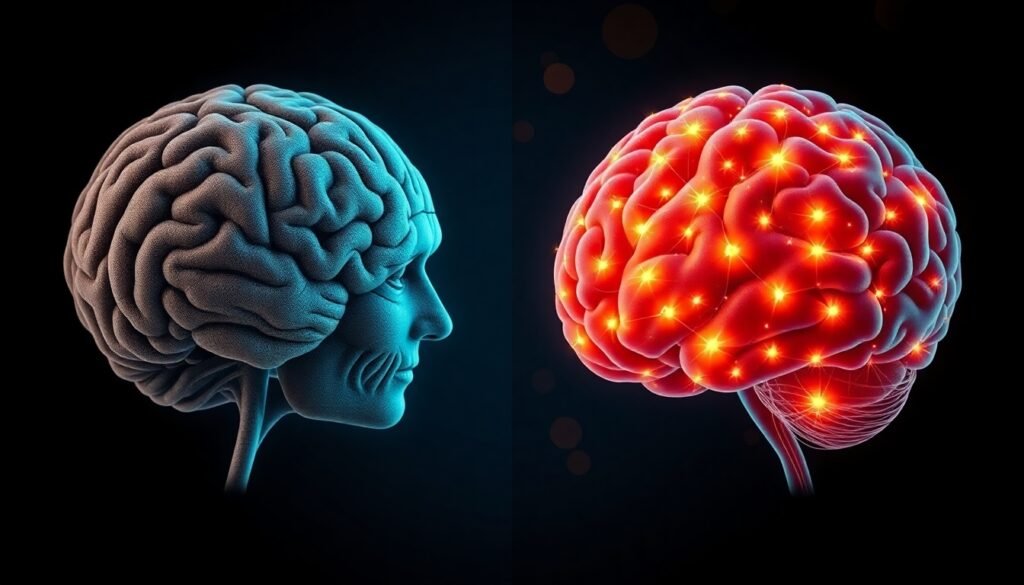
The results were striking. Individuals who reported higher levels of shyness consistently showed lower ReHo in a specific area of the cerebellum known as the right Crus I. This suggests that in shyer individuals, the spontaneous neural firing in this region is less coordinated. This lack of local synchrony could indicate a disruption in how the brain integrates internal emotional states with external social cues, potentially leading to the hesitation and inhibition characteristic of shyness.

The Motivational Tug-of-War: Introducing the BIS
Finding a correlation between cerebellar activity and shyness is one thing, but understanding why this link exists is the next crucial step. To bridge this gap, the researchers turned to a well-established psychological framework: the reinforcement sensitivity theory, which involves two core motivational systems.
- The Behavioral Activation System (BAS): This is your brain’s ‘gas pedal.’ It drives you toward rewarding experiences, like seeking out friends, pursuing a promotion, or trying a new hobby. It’s the system of approach and engagement.
- The Behavioral Inhibition System (BIS): This is your brain’s ‘brake pedal.’ It makes you cautious and avoidant in the face of potential threats, punishment, or uncertainty. It’s the system that tells you to hang back and assess the situation before jumping in.
Shyness is often conceptualized as a conflict between these two systems: a desire to approach (driven by the BAS) is overpowered by a fear of negative outcomes (driven by the BIS). Participants in the study completed questionnaires to measure the sensitivity of their individual BIS and BAS. As predicted, higher shyness scores were strongly associated with a more sensitive BIS, while the BAS showed no significant relationship.
Here’s where it gets fascinating. The study found that the BIS acted as a mediator between cerebellar activity and shyness. In other words, the reduced neural synchrony in the cerebellum appears to influence a person’s sensitivity to social threats (the BIS), which in turn manifests as shy behavior. The cerebellum, acting as a convergence zone for emotional and cognitive signals, may be helping to arbitrate this internal conflict. When its local activity is out of sync, it may tip the scales in favor of inhibition and avoidance.
Implications for Understanding and Intervention
This research does more than just add a new region to the brain map of personality; it reframes our entire understanding of shyness. By demonstrating a link to the brain’s intrinsic, resting-state activity, it underscores that shyness is not merely a reaction to social situations but may be a reflection of a person’s baseline neurobiology.
These findings open up exciting avenues for future interventions. If lower cerebellar synchrony and a hyperactive BIS are at the core of shyness, it may be possible to develop targeted therapies. For example, non-invasive brain stimulation techniques could potentially be used to modulate activity in the cerebellum. Similarly, cognitive-behavioral therapies could be refined to specifically target the overactivation of the Behavioral Inhibition System, helping individuals better manage their response to perceived social threats.
Of course, this study is an important first step, and more research is needed. The findings were based on a sample of university students, and future studies will need to explore if these patterns hold true across different age groups, cultures, and in clinical populations, such as those with social anxiety disorder. Longitudinal studies could also track how these brain patterns develop over time, answering a critical question: is lower cerebellar ReHo a trait we are born with, or does it emerge as a result of repeated social withdrawal?
Ultimately, this study offers a more compassionate and nuanced view of shyness. It suggests that the shy brain isn’t broken or deficient, but rather uniquely tuned to anticipate, evaluate, and sometimes avoid the complex and unpredictable dance of social connection. As we continue to unravel the intricate relationship between our brains and our personalities, we move closer to a world where we can better understand and support every type of mind.
Reference
Li, L., Wang, Y., Geng, F., Liu, W., & Luo, Y. (2024). Associations between trait shyness and cerebellar spontaneous neural activity are mediated by behavioral inhibition. Personality and Individual Differences, 226, 112791. https://doi.org/10.1016/j.paid.2024.112791