A groundbreaking study reveals how the brain flexibly rewires its communication channels by balancing two types of neural inhibition, shedding light on the intricate dance between memory, learning, and attention.
Ever notice the difference between walking into your familiar kitchen and stepping into a bustling, foreign marketplace for the first time? In one scenario, your movements are automatic, guided by well-worn memories. In the other, your senses are on high alert, absorbing every new sight, sound, and smell. This fundamental difference in experience isn’t just a feeling—it’s the result of a sophisticated switch deep within your brain, a mechanism that decides whether to rely on the past or embrace the present. Neuroscientists have just uncovered how this switch works, and it’s all down to the rhythmic hum of your brain’s electrical activity.
The Brain’s Orchestra
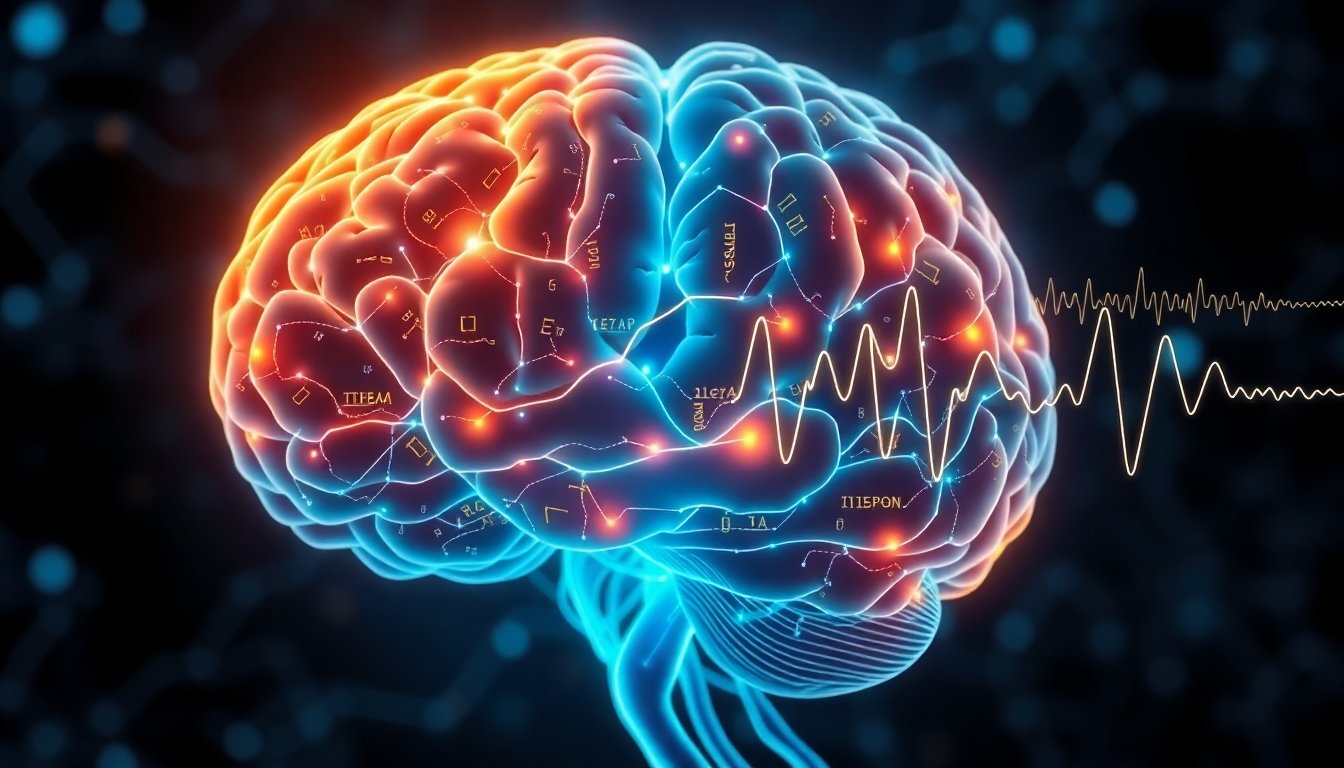
Our brains are never truly silent. They are constantly abuzz with electrical signals, which organize themselves into rhythmic patterns known as brain waves or neural oscillations. Think of it as a complex orchestra, with different sections playing at different tempos. Among the most crucial players are the slow, rolling theta rhythms (often associated with memory and navigation) and the fast, buzzing gamma rhythms (linked to active information processing and sensory perception). For a long time, the prevailing theory was that the slow theta waves acted as a conductor, organizing the activity of the faster gamma waves. But a new international study suggests the relationship is far more dynamic—a two-way conversation rather than a one-way command.
Familiar Roads vs. New Frontiers
A team of researchers, led by Claudio Mirasso at the Institute for Cross-Disciplinary Physics and Complex Systems (IFISC) and Santiago Canals at the Institute for Neurosciences (IN), focused on the hippocampus, the brain’s memory hub, and its connection with the entorhinal cortex, a key gateway for sensory information. Using a combination of advanced computational models and experimental recordings from rats, they discovered that the brain operates in two distinct communication modes depending on the context.
When in a familiar environment, the brain prioritizes memory recall. It favors a direct, well-trodden communication path from the entorhinal cortex to the hippocampus. This mode is like driving home on a familiar route; you don’t need to pay attention to every street sign because the path is already etched in your memory. The brain efficiently reactivates existing knowledge.
However, when faced with novelty, the brain switches gears. It activates a different mode that integrates new sensory information with stored memories. This allows for memory updating and learning. It’s like exploring a new city, where you constantly check your map (your memory) while also taking in the new streets and landmarks around you.
The Master Switch: A Tale of Two Inhibitions
So, what flips this critical switch? The study, published in PLoS Computational Biology, pinpoints the mechanism: a delicate balance between two fundamental types of inhibitory circuits in the brain. Inhibition, in neuroscience, isn’t a bad thing; it’s the essential process of "quieting" certain neurons to allow others to communicate clearly. It’s how the brain filters out noise and directs the flow of information.
The two types of inhibition identified are:
- Feedforward Inhibition: This is like a gatekeeper that screens incoming information before it reaches the main processing area. The study found this mode leads to gamma rhythms influencing theta rhythms (gamma-to-theta). This is the dominant mode in familiar settings, where the brain is focused on processing established memory pathways.
- Feedback Inhibition: This acts more like a quality control manager, modulating the output after information has been processed. This mode produces the more traditional theta-to-gamma interaction, where slow waves organize faster ones. It becomes dominant in novel situations, allowing the brain to integrate new sensory data with existing memories.
"This work provides a mechanistic explanation of how the brain flexibly changes communication channels depending on the context," explains Dimitrios Chalkiadakis, the study’s first author. "By adjusting the balance between different types of inhibition, circuits define which inputs to prioritize, whether from memory-related pathways or from new sensory information." The beauty of this system is its fluidity. The transition isn’t an on/off flip but a continuous slide, allowing the brain to fine-tune its processing strategy based on the demands of the moment.

A New Paradigm of Brain Communication
This discovery challenges the long-held, one-sided view of how brain rhythms interact. The relationship is bidirectional. Sometimes slow theta waves orchestrate fast gamma activity, but at other times, the fast gamma waves take the lead, influencing the theta rhythm.
"Our results help unify opposing views on how brain rhythms of different frequencies interact," says Mirasso. Canals adds, "Rather than being purely local or inherited from earlier regions, these rhythms emerge from the interaction between external inputs and local inhibitory dynamics. This dual mechanism enables the brain to optimize information processing under different conditions." This dynamic interplay allows for a much more flexible and powerful information processing system than previously imagined.
Beyond Memory: Implications for Attention and Disease
The implications of this flexible switching mechanism likely extend far beyond memory and navigation. The researchers suggest it could be a general principle for how the brain directs information flow for other cognitive functions, such as attention. When you focus on a conversation in a loud room, your brain is actively inhibiting distracting sounds. This process could be governed by the same balance of inhibitory circuits, prioritizing one stream of sensory information over others. In fact, recent studies in humans have already shown brain activity patterns consistent with the team’s computational model.
Looking ahead, understanding this fundamental mechanism could be transformative for medicine. The researchers plan to expand their model to better understand how this delicate balance is disrupted in neurological and psychiatric conditions. In disorders like epilepsy, addiction, or Alzheimer’s disease, the flow of information in the brain is often dysregulated. "Studying these dynamics at a mechanistic level could ultimately inspire new therapeutic intervention strategies," the authors conclude. By learning to modulate this inhibitory balance, we might one day be able to correct faulty brain communication and treat these devastating diseases.
Conclusion
The brain’s ability to seamlessly navigate between the comfort of the known and the challenge of the unknown is one of its most remarkable feats. This study pulls back the curtain on this process, revealing an elegant and efficient system governed by the push and pull of two inhibitory forces. It’s a reminder that within the rhythmic hum of our brain waves lies a dynamic, adaptable network, constantly rewiring itself to make sense of our world. This secret switch isn’t just a key to understanding memory; it may be a fundamental principle of cognition itself.
Reference
Chalkiadakis, D., et al. (2025). [Title of the specific study not provided in source material]. PLoS Computational Biology.
Note: The full citation details, including the specific article title and DOI, were not available in the provided summary. The reference reflects the information given.