New research uncovers a specific population of brain cells that acts as a crucial switch, helping us make brave choices when faced with the conflict between anxiety and essential needs like eating.
Life is a constant negotiation between risk and reward. For any animal, including humans, survival often depends on the ability to override fear to achieve a vital goal. Imagine a mouse needing to cross an open field to find food, fully aware that predators could be watching. Or consider a person with social anxiety who must give a career-defining presentation. In these moments, a battle wages in the brain: the primal need for safety clashes with the drive to eat, explore, or succeed. A breakdown in the brain’s ability to manage this conflict can lead to debilitating anxiety and eating disorders. Now, a groundbreaking study published in Nature Neuroscience has identified a specific group of neurons that acts as a critical mediator in this battle, a kind of “courage circuit” that helps tip the scales toward adaptive action.
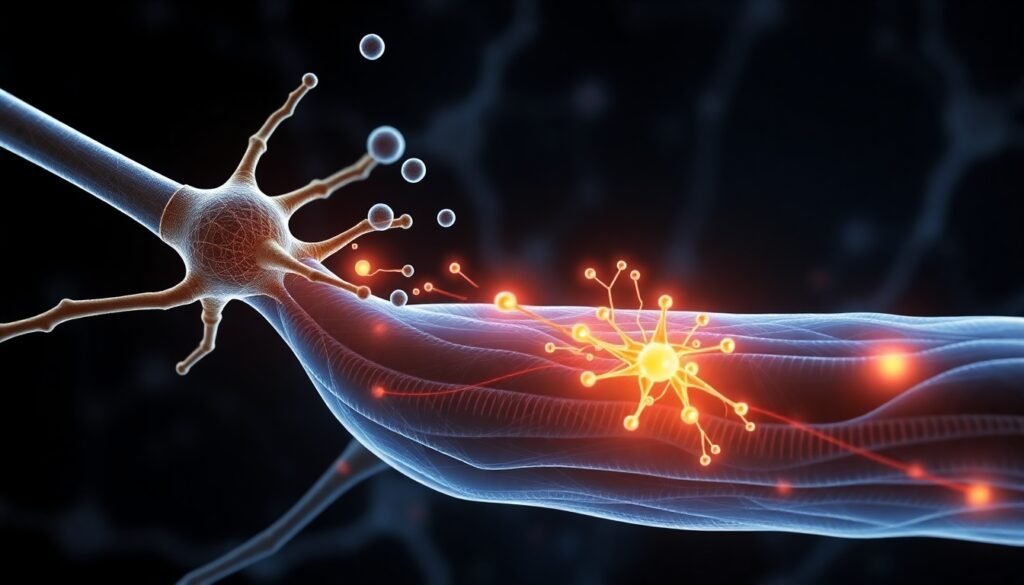
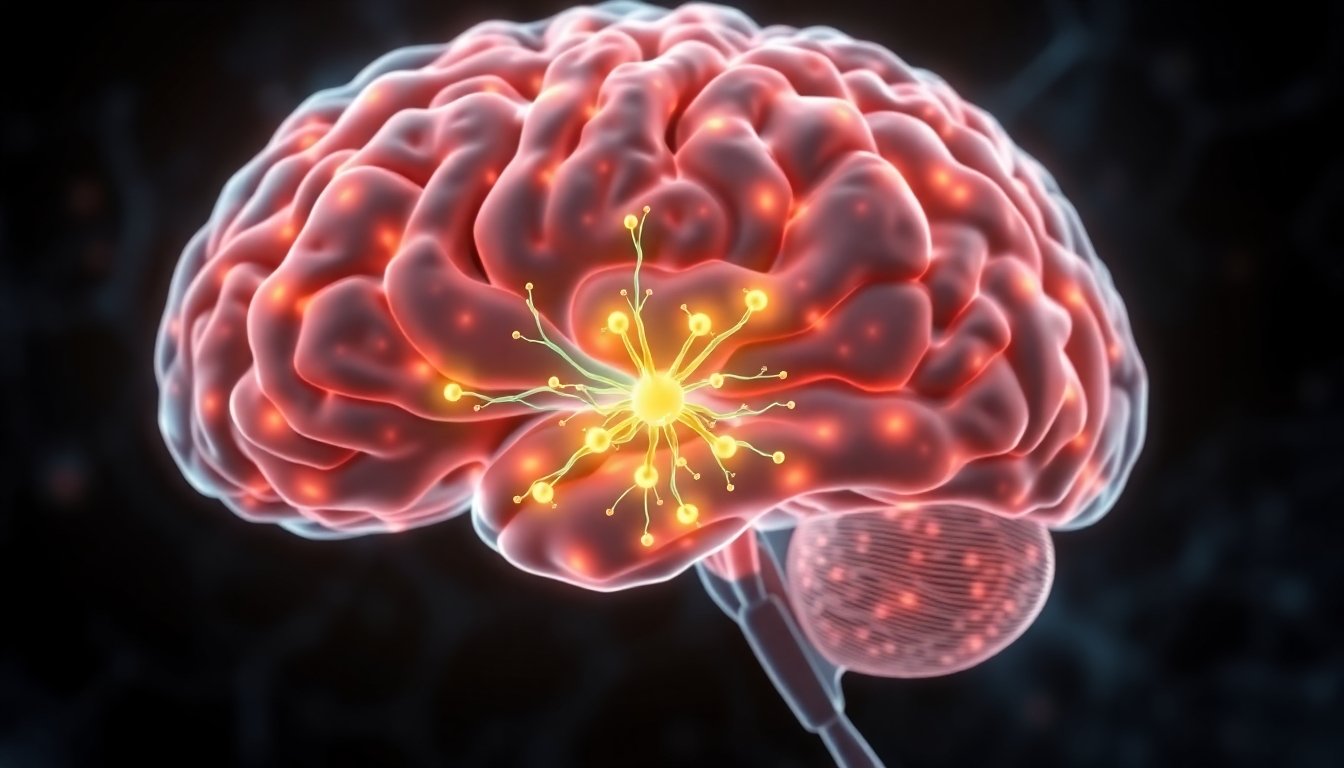
Researchers focused on a deep brain region known as the lateral hypothalamus (LH), a hub for regulating fundamental behaviors like eating and drinking. Within this area, they investigated a unique population of neurons that express receptors for leptin (LepR), a hormone primarily known for signaling satiety. These LepR-LH neurons, as they are called, have emerged as the heroes of this story, playing a pivotal role in counteracting anxiety to allow for necessary behaviors.

To test the function of these neurons, scientists used a classic anxiety test for mice called the elevated plus maze. This apparatus is a plus-shaped platform raised off the ground, with two arms enclosed by walls (the “safe” zone) and two arms left exposed (the “anxiogenic” or scary zone). By monitoring the brain activity of mice as they explored the maze, the researchers discovered that the LepR-LH neurons became significantly more active when the animals ventured into the exposed, open arms. It was as if these cells were firing up to provide a dose of courage.
To confirm this, they took it a step further. Using optogenetics—a technique that allows scientists to control neurons with light—they artificially activated the LepR-LH neurons. The result was striking: the mice spent significantly more time exploring the scary open arms, demonstrating a clear reduction in anxiety-like behavior. Conversely, when the function of these neurons was impaired, the mice became more timid. This established a direct causal link: the activation of LepR-LH neurons helps to suppress anxiety and promote exploration.
But these neurons don’t operate in a vacuum. The brain is a complex network of checks and balances. The study revealed that the prefrontal cortex (PFC), a region associated with higher-order thinking and emotional regulation, acts as a brake on this courage circuit. The PFC sends inhibitory signals to the LepR-LH neurons, and this effect was particularly strong in mice that were naturally more anxious. When researchers stimulated the pathway from the PFC to the LH, the mice became more anxious, avoiding the open arms of the maze. This finding paints a picture of a neural tug-of-war: the PFC can amplify anxiety by suppressing the very neurons that are trying to quell it.
This dynamic becomes even more critical when another powerful drive enters the equation: hunger. In another experiment, hungry mice were placed in a brightly lit, new arena with food in the center—a scenario that creates a conflict between the drive to eat and the fear of the exposed space. In highly anxious animals, a fascinating pattern emerged. Just before they finally gathered the nerve to approach the food, their LepR-LH neurons showed a powerful surge in activity. This burst of neural firing appeared to be the final push needed to overcome their fear. When the researchers artificially activated these neurons, the anxious mice decided to eat much sooner. This demonstrates that the LepR-LH circuit is not just a general anxiety-reducer; it specifically helps to facilitate essential behaviors like feeding in threatening contexts.
Perhaps the most profound implications of this research relate to eating disorders like anorexia nervosa, which is often accompanied by severe anxiety and a compulsion for excessive exercise. To investigate this, the team used a mouse model of activity-based anorexia (ABA), where mice have limited access to food but unlimited access to a running wheel. This setup often leads to a dangerous cycle of reduced eating, weight loss, and hyperactivity.
The study found that in this model, hyperactivity was strongly correlated with anxiety levels. The researchers hypothesized that the excessive running might be a maladaptive attempt to relieve anxiety. When they looked at the LepR-LH neurons, they found that their activity increased during running, but only during the food-restriction phase. Critically, in high-anxiety animals, it took much more running to achieve the same level of LepR-LH activation compared to low-anxiety animals. This suggests that highly anxious individuals might be running excessively in a desperate attempt to activate this anxiety-dampening circuit.
The final, and most compelling, piece of evidence came from one last experiment. The scientists chemogenetically activated the LepR-LH neurons throughout the ABA model. The result was astonishing: it completely prevented the excessive, compulsive running that typically develops during food restriction. By directly reducing the underlying anxiety, the need for the maladaptive coping behavior disappeared. This reframes hyperactivity in anorexia not just as a symptom, but as a desperate, and ultimately harmful, attempt to self-medicate anxiety.
In conclusion, this research provides a detailed map of a crucial neural circuit that governs the balance between fear and function. The LepR-LH neurons act as an adaptive switch, enabling animals to explore, eat, and conserve energy by tamping down anxiety when necessary. The study also sheds light on how this system can be dysregulated, particularly through overpowering inhibitory signals from the prefrontal cortex in high-anxiety individuals. By identifying this circuit and its connection to genes linked with anorexia and anxiety disorders, this work opens up exciting new avenues for developing targeted therapies that could one day restore balance to this delicate neural system and offer new hope to those struggling with these debilitating conditions.
Reference
Leib, D. E., D’Agostino, G., Varin, C., et al. (2024). A lateral hypothalamic neuronal population expressing leptin receptors counteracts anxiety to enable adaptive behavioral responses. Nature Neuroscience. https://doi.org/10.1038/s41593-024-01651-y